

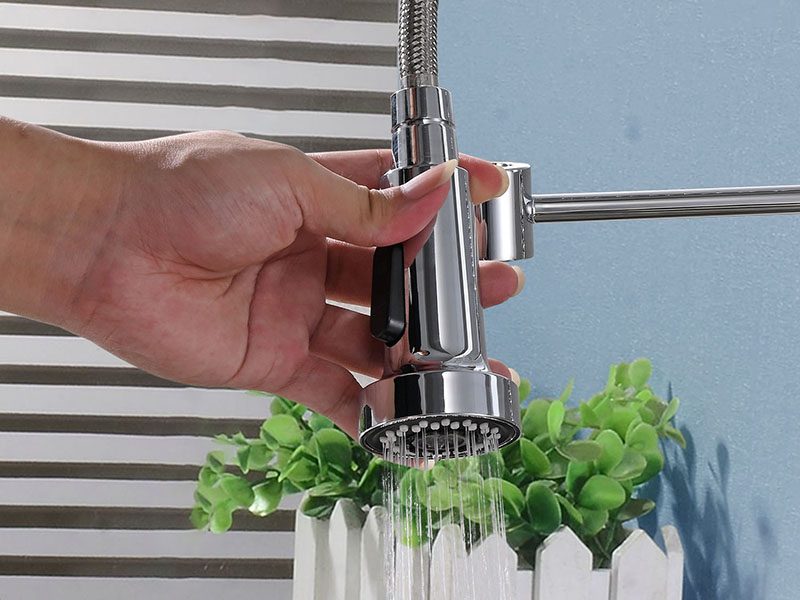
When a customer leaves a 1-star review for a pull-out kitchen faucet, the brass body or ceramic cartridge is rarely at fault. Over 80% of post-sale warranty claims trace back to one overworked component hidden underneath the sink: the flexible hose assembly.
A frayed outer mesh locks the line inside the spout. High surface drag stops the counterweight from snapping the spray head back into place. A cheap inner liner cracks under normal household water pressure spikes, leaking into the customer’s kitchen cabinet. A single hose failure can quickly erase your profit margin on an entire container shipment.
The Engineering Breakdown: Why Standard Pull-Out Faucet Hoses Fail?
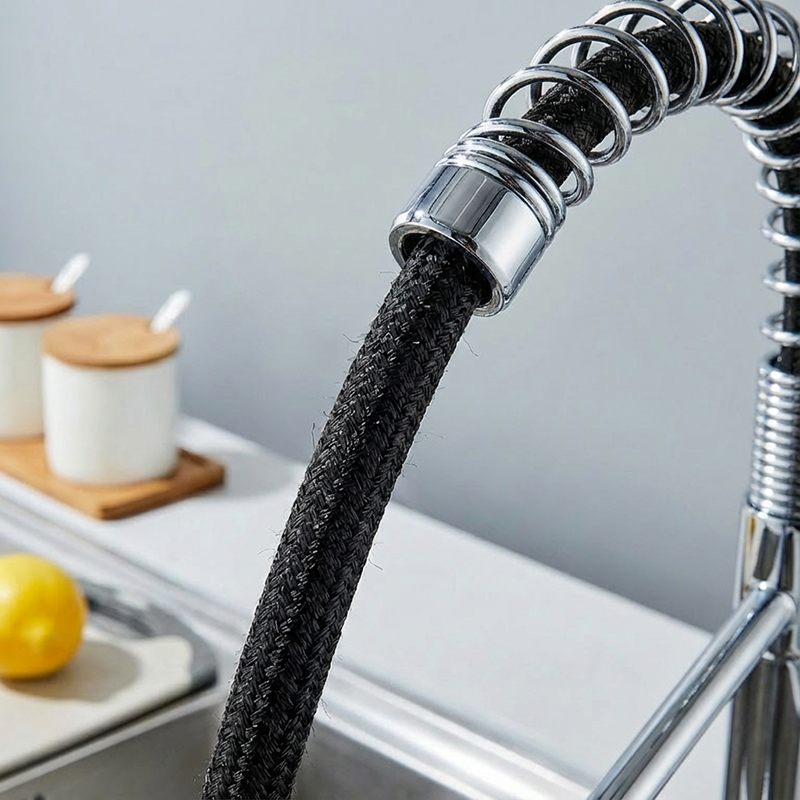
Braid Fraying and Surface Drag
Every time an end-user pulls the sprayer, the hose grinds against the spout’s interior wall and guide collar. Low-cost polyester braiding starts fuzzing well before 10,000 pulls, choking the guide hole. Stainless steel wire looks tough initially, but constant flexing creates sharp micro-burrs that scratch internal brass sleeves and create an unpleasant grinding noise.
Friction Drag Causing Retraction Stalls
If you receive customer complaints about a pull-down kitchen faucet spray head not retracting smoothly, surface drag is almost always the cause. High friction between the braid and the guide sleeve overpowers the downward pull of the gravity ball. When the hose also swells from hot water exposure, the weight simply cannot pull the sprayer back into its docked position.
Thermal Degradation and Under-Sink Leaks
Kitchen supply lines routinely cycle between cold water and 80°C hot water. Budget PVC inner tubes leach plasticizers over time, turning stiff and cracking under normal water hammer shock. EPDM handles heat better, but repeated expansion and contraction cycles cause stress fractures right where the tube crimps into the metal end fitting.
50,000-Cycle Performance Data Across 3 Hose Configurations
Our engineering team tested three common hose configurations in our QA lab, putting them through 50,000 full-stroke pullout cycles under dual water temperatures (23°C and 80°C) to simulate ten years of heavy residential use.
| Performance Metric | Polyester + PVC Liner | Stainless Steel + EPDM Liner | High-Density Nylon + PEX-b Liner |
| Coefficient of Friction (CoFF) | 0.42 (High resistance, frequent sticking) | 0.35 (Scratches interior walls, noisy) | 0.18 (Ultra-smooth, silent glide) |
| 50,000-Cycle Outer Braid Condition | Severe fraying; broken strands > 15% | Wire deformation & sharp micro-burrs | Zero visible fraying; structure intact |
| Burst Pressure (23°C / 80°C) | 1.8 MPa / 0.8 MPa (260/116 PSI) | 3.2 MPa / 1.5 MPa (464/217 PSI) | 4.5 MPa / 2.5 MPa (652/362 PSI) |
| Retraction Resistance Drag Increase | +65% (Stalls midway, fails to dock) | +35% (Sluggish, needs manual push) | < 8% (Consistently smooth retraction) |
| Drinking Water Compliance | Fails NSF/ANSI 61 | Passes NSF 61; mild odor at high temp | Passes NSF/ANSI 61 & 372 (Odorless & Lead-Free) |
| Estimated Overseas RMA Rate | > 8.5% (High financial risk) | ~ 2.5% (Substantial warranty claims) | < 0.3% (Ultra-low RMA rate) |
How to Build a Leak-Proof Pull-Out Faucet Hose Assembly
Material Pairing That Works
Specify high-density polymer nylon for the outer mesh alongside an NSF certified PEX-b pull-out faucet tube for the inner core. High-density nylon drops the friction coefficient to an ultra-low 0.18 for an effortless, whisper-quiet glide. Silane-crosslinked PEX-b maintains its structural memory and tensile strength even under continuous hot water exposure.
Tight Tolerances at Key Contact Points
Press a self-lubricating POM (polyoxymethylene) sleeve inside the spout outlet. This creates a low-friction polymer-on-polymer contact zone with the nylon braid. Keep crimping sleeve and weight clamp tolerances within ±0.15mm so you never pinch the water channel inside or cause internal flow restriction.
Factory FQC Inspection Protocol
Write these three mandatory checks directly into your purchase contracts:
- Dynamic Pressure Cycling: Run 1,000 pulls under continuous 1.2 MPa water pressure to verify zero moisture or weeping at crimped fittings.
- Bend Radius Flow Test: Flex the hose to a tight 30mm radius while running water; flow reduction must stay below 5%.
- Crimp Tensile Pull: Apply 300N (~30kg) of axial tension across end fittings for 60 seconds to ensure zero sleeve slippage.
Sourcing FAQs from Procurement & QC Teams
Does switching to PEX-b and high-density nylon wreck the BOM cost?
Upgrading to a commercial grade pull-out kitchen faucet hose with PEX-b adds roughly $0.80 to $1.50 USD per unit. Compare that to the cost of processing a single e-commerce return, paying return shipping fees, and absorbing negative customer reviews. The small up-front investment pays for itself on your first shipment by virtually eliminating warranty claims.
How do QC auditors quickly spot PEX-b versus PVC or EPDM during factory inspections?
Use a simple hot water soak test. Submerge hose samples into 70°C water for 5 minutes. PVC turns soft like cooked pasta and emits a chemical smell. EPDM releases a rubber odor and recovers sluggishly when bent. PEX-b remains firm, completely odorless, and snaps back to its original shape instantly.
Will this configuration pass North American and European plumbing codes?
Yes. Engineering-grade PEX-b hose assemblies pass all major international standards, including NSF/ANSI/CAN 61, NSF 372 (lead-free), cUPC (North America), and WRAS (UK), ensuring smooth customs clearance and market access.
Work with Topcraft on Your Next Production Run
A durable, smooth-gliding hose assembly is critical to how buyers judge your fixture’s overall quality. At Topcraft, we engineer kitchen and bath solutions designed to protect your brand reputation and eliminate post-sale warranty expenses.
Whether you need a full pull-out kitchen faucet hose replacement specification review or want to test our 50,000-cycle certified PEX-b samples on your testing rig, the Topcraft engineering team is ready to support your next project. Reach out to our team today to get sample kits sent directly to your QA lab.