

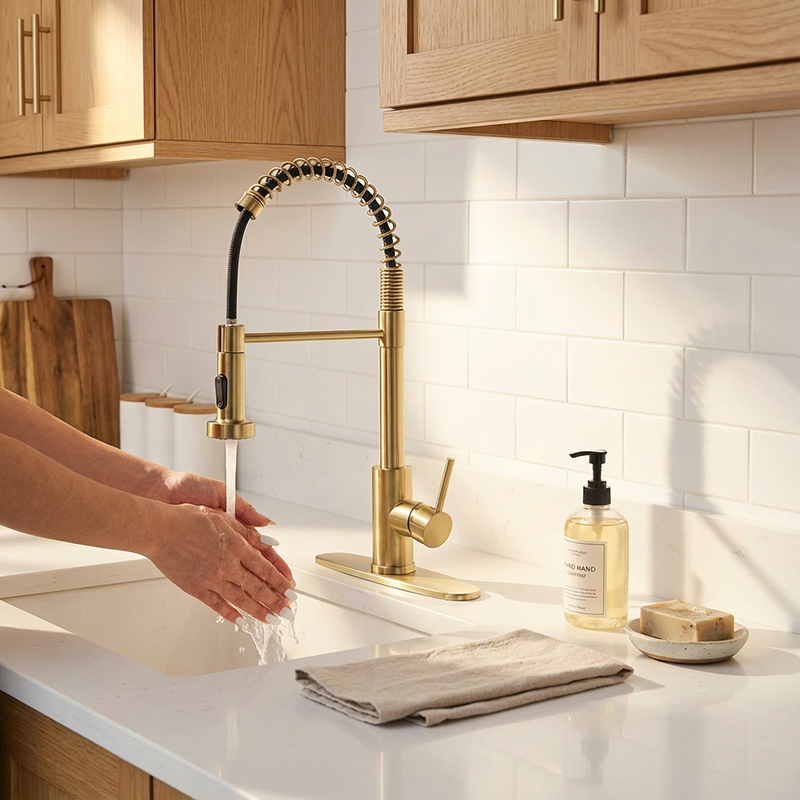
Have you ever experienced this highly frustrating moment? You spent hundreds of dollars on a premium pull-out faucet, only to find that within six months, the spray head sags like a limp noodle, refusing to retract and hanging messily over your sink. Or perhaps, despite daily wiping, the chrome finish develops stubborn black spots and rust, peeling off like paper and cutting your fingers.
As the ultimate workhorse of modern kitchens and bathrooms, a poorly chosen pull-out faucet turns daily chores into an ongoing headache. Today, we are stripping away the marketing jargon. We dive deep into the physical engineering and metallurgical science behind high-end hardware, showing you how to permanently solve faucet retraction and rusting issues!
1. Retraction Failure: Gravity Ball vs. Tension Spring — Who is “Time’s Friend”?
The core of any pull-out faucet is its retraction system. Currently, there are two primary technologies on the market: Gravity Ball and Mechanical Tension Spring. Their physical failure mechanisms are vastly different:
A. The Gravity Ball System
- Working Principle: Pure Newtonian physics. A heavy block weighing 300g – 450g (usually cast iron or lead encased in plastic) is clamped onto the pull-out hose underneath the sink. Pulling the spray head lifts the gravity ball; releasing it lets gravity smoothly pull the hose and spray head back into place.
- Why It “Fails” (The Truth): Gravity does not expire. If your gravity ball faucet fails to retract, it is due to two localized friction factors:
- Under-Sink Obstructions: Modern under-sink cabinets are packed with garbage disposals, water purifiers, shutoff valves, and drainpipes. The moving gravity ball gets caught or wedged between these appliances and hoses, locking it in place.
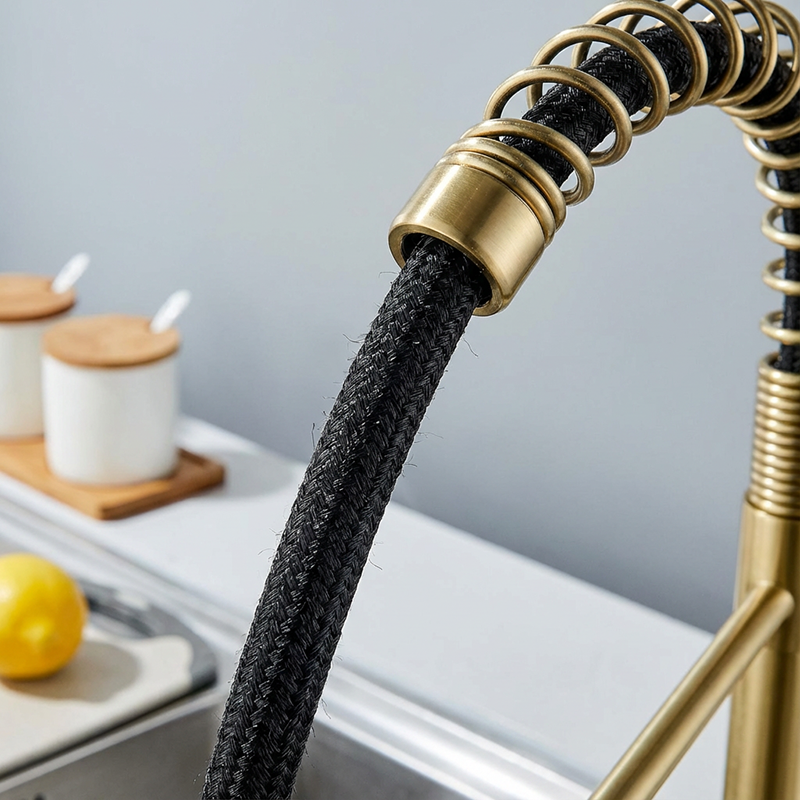
- Hose Deterioration: With long-term use, cheap braided nylon hose jackets fray and fuzz. This drastically increases the sliding friction coefficient against the brass or plastic guide sleeve inside the faucet body. When the friction force exceeds the gravity pull, retraction stalls.
B. The Tension Spring System
- Working Principle: Mechanical spring tension. An internal steel spring is extended when the spray head is pulled out, storing mechanical energy. Letting go releases the force (governed by Hooke’s Law: $F = -kx$) to snap the head back.
- Why It Fails (The Truth): Tension springs face dual physical and chemical deterioration:
- Metal Fatigue & Plastic Deformation: Repeated stretching causes microscopic dislocations in the spring steel. Over thousands of cycles, the spring constant $k$ degrades. Within 2 to 5 years, the spring suffers permanent plastic deformation and sags permanently.
- Stress Corrosion & Snapping: Under-sink environments are notoriously damp. If the spring is not made of ultra-high-grade stainless steel or lacks protective coating, it experiences Stress Corrosion Cracking (SCC), leading to sudden snapping.
| Comparison Dimension | Gravity Ball System (Highly Recommended) | Mechanical Tension Spring |
| Theoretical Lifespan | Near infinite (gravity as a physical constant never degrades) | Limited (typically 2-5 years before noticeable fatigue) |
| Failure Rate | Extremely Low (only vulnerable to physical jamming) | Moderate to High (loss of tension, rust, structural snapping) |
| Space Requirement | High (requires a vertical, clear path for movement) | Extremely Low (ideal for tight, cluttered cabinets) |
| Ergonomic Pull Feel | Increasing tension (natural ergonomic feedback) | Uniform resistance, but tends to become mushy over time |
💡 Pro-Installer Hack: Under-Sink Cable Management
Even if your under-sink space is fully loaded with water filters and garbage disposals, we still highly recommend the Gravity Ball system. During installation, simply use heavy-duty zip-ties or cable organizer brackets to secure all electrical wires and water hoses to one side, leaving a dedicated, friction-free vertical corridor for the gravity ball to drop.
2. Combating Rust and Corrosion: Materials and Surface Finishing Decoded
Many homeowners find their beautiful faucets looking tarnished and covered in pitting, black specks, or peeling chrome after a short period. Because kitchen and bath environments are hot, humid, and chemically active, you need to understand the science of materials to buy smart.
A. The Core Substrate: The “Skeleton” of the Faucet
The substrate is your primary shield against high water pressure, chemical corrosion, and mechanical failure:
- HPb59-1 Solid Brass (Recommended): The industry standard for premium sanitary ware. Due to the natural antimicrobial properties of copper, brass naturally inhibits bacterial growth. Solid brass is robust, machines precisely, and matches the thermal expansion of chrome-nickel coatings, preventing plating delamination over decades.
- SUS304 Stainless Steel (Recommended): Lead-free, rust-resistant, and chemically stable. Brushed stainless steel offers a sleek, modern industrial look and has no electroplated layer to peel. However, in high-humidity or coastal saltwater environments, microscopic rust spots can form if the surface is not kept clean of alkaline mineral buildup.
- Zinc Alloy (Absolute Deal-breaker): Commonly used in cheap, unbranded faucets. Zinc is chemically reactive. Once water inevitably breaches the razor-thin plating, zinc undergoes galvanic corrosion. The interior structurally disintegrates into powdery residue, causing catastrophic crack failure and heavy leaking.
B. Surface Finishing: The “Skin” of Defense
- PVD (Physical Vapor Deposition) Plating: Conducted in a high-vacuum chamber where titanium or chromium is vaporized and blasted onto the faucet body. PVD creates an incredibly hard, scratch-resistant surface. This allows for stunning finishes like gunmetal grey and brushed gold that resist fingerprints, chemical cleaners, and micro-scratches.
- Multi-Layer Electroplating: The classic finish. The perfect recipe requires: Brass substrate + Acid Copper (for smoothness) + Semi-Bright/Bright Nickel (for corrosion barrier) + Chrome (for hardness and luster). Ensure the nickel layer is $\ge 8\,\mu\text{m}$ and chrome is $\ge 0.25\,\mu\text{m}$.
⚠️ Warning: How to Decipher Salt Spray Test Standards
Ignore generic marketing claims of “corrosion resistant.” Ask directly for the official lab reports and check the 24-Hour Acid Salt Spray Test (ASS) rating.
- Neutral Salt Spray (NSS): Simulates standard humidity. Quality faucets should score Grade 10 (zero flaws) after 24 hours.
- Acid Salt Spray (ASS): 3 to 4 times more aggressive. For coastal properties or highly active kitchens, always buy a faucet certified to achieve ASS 24h Grade 9 or 10 to prevent coastal air salinity from pitting the hardware.
3. The Hardcore Buying Decision Matrix (The 1-Minute Checklist)
- Retraction Mechanism: Physics over springs. Always choose a Gravity Ball system unless cabinet space is physically too confined.
- Core Material: Opt for heavy-weight, gravity-cast H59/H62 Brass for high-end brilliance, or SUS304 Stainless Steel for a lead-free brushed look. Avoid zinc alloys.
- Surface Tech: Choose PVD coatings for colors (gunmetal, brushed gold) as they are 5x more scratch-resistant than painted or basic electroplated layers. Verify ASS 24h ≥ Grade 9 certification.
- The Details: Ensure the pull-out hose features a double-interlocked stainless steel braid or ultra-flexible nylon over a thick silicone core to prevent friction fuzzing. Look for industry-leading ceramic cartridges (e.g., Sedal or Wanhai).