

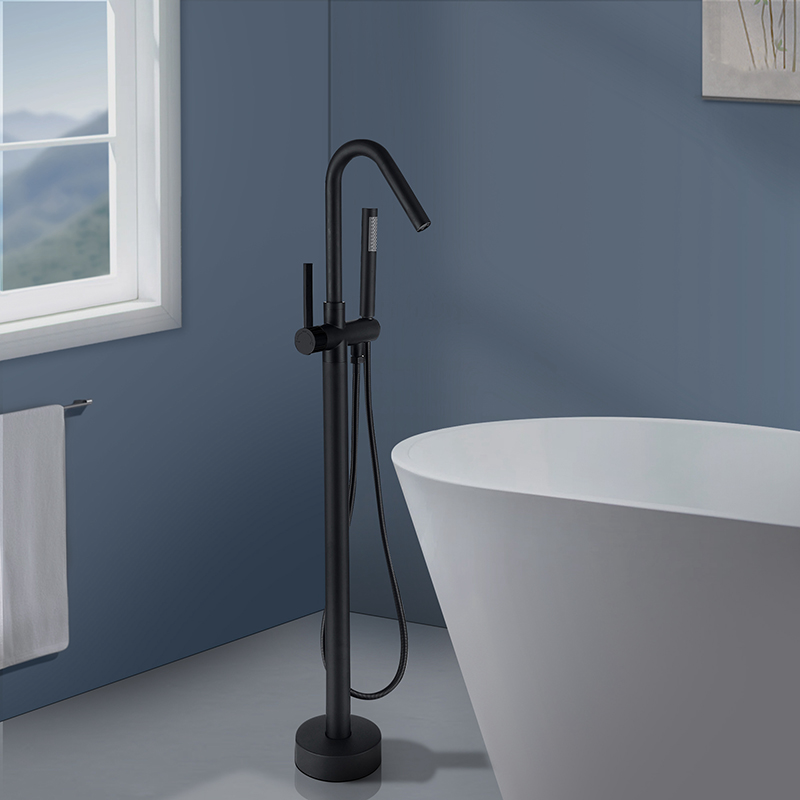
Freestanding tub fillers continue to be a high-value fixture choice for boutique hotels, vacation rentals and upscale residential builds. Even so, many purchasing teams overlook installation, structural and hydraulic challenges unique to floor-mounted tub faucets. Units that look identical in photos can show wide differences in long-term reliability after 6 to 18 months of regular, heavy use. Poor selections lead to warranty claims, costly site reworks and chargebacks. This article breaks down common field failures and lays out a clear specification checklist buyers should confirm before placing bulk orders.
1. Rough-In Misalignment Is the Leading Cause of Job-Site Rejects
Unlike deck-mounted roman tub faucets, freestanding tub fillers require hot and cold supply stubs set in place before flooring, tile and tub installation. Rough-in dimensions are model-specific and rarely interchangeable between manufacturers.
A frequent issue arises when the rough-in kit is sourced separately from the filler itself. Mismatched center-to-center inlet spacing, supply depth or base plate cutout dimensions can make proper installation impossible without cutting into finished flooring.
A common mistake buyers make is finalizing the tub filler selection after rough plumbing work has already been completed. This forces installers to use offset adapters to compensate, creating concealed leak points below the finished floor.
For consistent results, always review the official rough-in drawing, confirm the matching rough-in kit part number and account for finished floor thickness before releasing a purchase order. For large hotel rollouts, standardizing on one rough-in specification across all locations cuts down installer error significantly.
2. Unstable Bases Create Hidden Subfloor Leaks
Every time someone turns the handle of a freestanding filler, torque transfers directly into the floor flange. Budget models often cut costs by using thin stamped base plates, undersized anchor hardware and decorative plastic covers that offer no structural support.
Problems develop gradually. Minor wobble during operation creates repeated stress on compression fittings and braided supply lines. Slow leaks start and go undetected until water damage shows up on tile, wood or finished ceilings below.
A reliable unit features a solid brass base flange and anchoring hardware suited for both wood subfloors and concrete slabs. Once fully secured, the assembly should not shift side to side when operated.
Sample testing tip: apply gentle side pressure at the end of the spout. There should be no movement at the base joint and no shifting sound from internal connections.
3. Diverter and Cartridge Problems on Units with Handshowers
Many premium freestanding tub fillers include a built-in diverter to switch flow between the tub spout and handheld sprayer. The diverter is usually less durable than the main flow cartridge and a frequent source of service calls.
Typical complaints include internal cross-leakage (water drips from the spout while the handshower runs), stiff or stuck diverters, and failure to fully shut off the secondary outlet.
For commercial applications, 35mm ceramic disc cartridges are the preferred option. Smaller cartridges carry a lower upfront cost but tend to drip and lose temperature stability faster with repeated use.
For single-handle models, test both hot and cold shutoff. When switching the diverter, water temperature should stay consistent with no sudden spikes of scalding hot water.
4. Flow Rate, Pressure and Fill Time Expectation Gaps
Buyers and end customers often judge tub fillers by how quickly they fill a tub. However, published GPM ratings do not always translate to fast fill times on site.
The tall vertical riser tube creates friction loss inside the fixture. At incoming pressure below 40 PSI, even fixtures with a high GPM rating will run noticeably slower.
Waterfall-style freestanding fillers are especially sensitive to inlet pressure. Under marginal pressure, the smooth sheet of water breaks apart into uneven streams or dripping, one of the most common complaints for luxury tub setups.
When sourcing, request factory performance test data rather than relying only on static GPM values. Document flow performance at both 40 PSI and 60 PSI to match typical pressure ranges in your target project regions.
5. Finish Durability and Hard Water Staining
Matte black, brushed gunmetal and brushed nickel finishes remain popular for freestanding tub fillers. Because these fixtures stand fully exposed in the bathroom, water spots and mineral deposits are far more visible than on sink faucets.
PVD coatings deliver better scratch and chemical resistance than standard electroplating. Powder or painted finishes tend to chip along the base edge, where install tools and routine cleaning contact the fixture.
One important specification note: a “PVD finish” should be applied over a brass body. Zinc alloy fixtures with PVD coating still carry elevated corrosion risk in humid bathrooms or areas with hard water.
6. Handshower Hoses and Accessories
The handshower hose is often treated as a simple add-on part, but it is a high-wear component.
Low-cost single-braid PVC hoses develop permanent kinks, crack with repeated hot water cycling and form pinhole leaks.
A better build uses double stainless steel braiding with an EPDM inner tube, standard 1/2 inch connections and a minimum length of 59 inches.
Check local plumbing codes for backflow requirements. Where required, confirm the diverter and handshower assembly includes proper backflow prevention.
Pre-Shipment Inspection Checklist for Bulk Orders
Before container loading, carry out PSI sampling on selected units covering these items:
- Cross-check rough-in measurements against the official engineering drawing
- Confirm base anchoring is secure with no wobble
- Pressure test at 1.5 times working pressure, hold for 60 seconds, no leaks at base, riser, cartridge or diverter
- Run repeated diverter switching tests, verify no cross-leakage
- Visual finish inspection: no pinholes, edge chips or uneven coating
- Verify all gaskets, hardware and rough-in components match the packing list
Final Takeaway
Freestanding tub fillers sell first on visual appeal, but the biggest reliability risks sit hidden in rough plumbing and subfloor connections. Successful sourcing is less about picking an attractive style and more about locking in dimensional specs, base construction, cartridge quality and pressure performance before production begins. Standardized parts reduce on-site failures and simplify spare part inventory over the life of the project.