

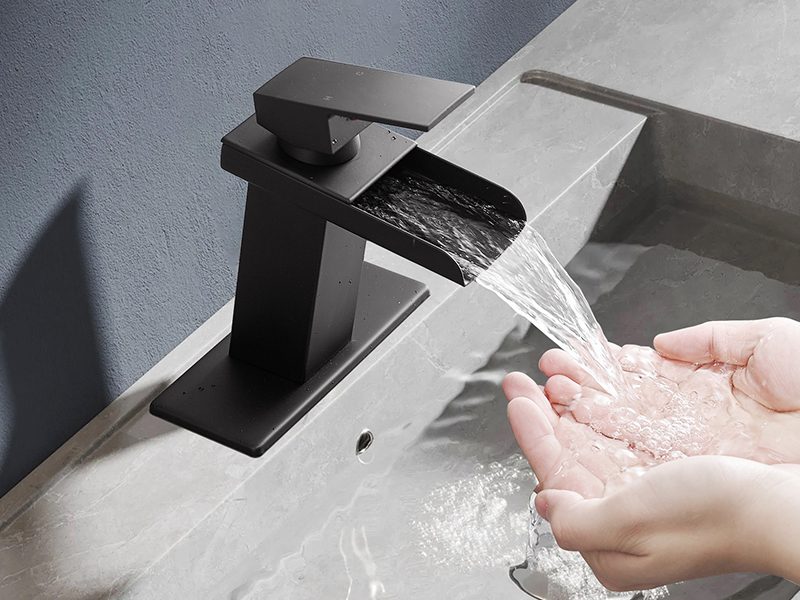
Matte black has become a popular finish for kitchen and bathroom faucets, particularly in modern residential projects. For importers, wholesalers, and e-commerce sellers, however, appearance is only one part of the equation. Finish durability can have a direct impact on product returns, warranty costs, and customer satisfaction.
Unlike cartridge or valve problems, finish defects are often visible and difficult to address after installation. Peeling around the spray head, scratches near the handle, or chipped edges can quickly turn an otherwise functional faucet into a customer complaint.
The durability of a black faucet depends on several factors, including the finishing process, the underlying substrate, surface preparation, and quality control. Two commonly used approaches are physical vapor deposition (PVD) and paint or powder coating. Although these finishes can look similar when new, their structures and performance characteristics differ.
1. PVD vs. Paint and Powder Coating: Understanding the Difference
PVD: A Thin Film Deposited on the Surface
Physical vapor deposition is a vacuum-based process used to deposit a thin film onto a prepared substrate. Depending on the process, the deposited material may include titanium-based or zirconium-based compounds, often combined with other elements to achieve the desired color and properties.
PVD films are generally thin and can provide good resistance to wear, scratching, and corrosion when the substrate, pretreatment, and deposition process are properly controlled. Their performance depends on factors such as film composition, thickness, adhesion, and the quality of the underlying surface.
It is important to clarify that PVD does not make a faucet immune to damage. A sufficiently severe impact or scratch can still damage the finish, and corrosion resistance cannot be assessed from the deposition process alone.
For buyers, the main advantage of PVD is its potential to provide a durable decorative surface without relying on a relatively thick organic coating. However, the term “PVD” by itself is not a guarantee of product quality. The complete finishing system must be evaluated.
Paint and Powder Coating: An Applied Organic Layer
Paint and powder coating form a different type of finish. Liquid paint is applied to the surface and cured, while powder coating involves applying dry powder, typically electrostatically, before curing it to form a continuous film.
Both methods can produce an attractive black finish, including matte and textured appearances. They are widely used across different product categories, and their performance varies with the coating formulation, pretreatment, application conditions, curing process, and film thickness.
A well-applied coating can offer satisfactory durability for its intended application. Problems are more likely when surface preparation is inadequate, the coating does not adhere properly, or the film is poorly controlled around edges and complex geometries.
If the coating becomes damaged, the exposed underlying layer may differ in color and appearance from the original finish. Depending on the damage and product construction, a localized repair may be impractical or visually inconsistent.
Which Finish Is More Durable?
Neither finish should be judged by appearance alone, and neither process guarantees a particular service life.
PVD is often a strong option when wear resistance is a priority. Paint and powder coating may also be suitable when the coating system has been properly engineered and tested for the intended conditions.
For wholesale buyers, the more useful question is not simply which process is better, but whether the supplier can demonstrate that the finished faucet meets the required performance standards.
2. Where Do Black Faucet Finishes Commonly Wear?
Certain areas deserve closer inspection during product development and incoming quality control.
- Handle bases and spout collars: These areas may experience repeated contact during normal use. Poor surface preparation or inadequate film coverage can make existing weaknesses more noticeable.
- Pull-down spray heads and docking areas: Repeated movement can cause friction between the spray head and its holder. The design of the docking mechanism, alignment, and contact materials all influence wear.
- Edges and corners: Surface geometry can affect coating coverage and film uniformity. These areas should be examined carefully rather than assuming that the finish is consistent across the entire faucet.
- Aerator threads and threaded connections: Assembly and disassembly can damage decorative finishes if the coating is not designed for these contact conditions. Inspect the threads and confirm that the finish does not interfere with assembly or sealing.
These locations are useful inspection points, but they should not be treated as evidence of a specific coating defect without further examination. Similar symptoms can result from poor adhesion, mechanical abrasion, impact damage, or inadequate corrosion protection.
The Substrate and Pretreatment Matter, Too
The visible black layer is only one part of the finishing system. The base material and any intermediate plating layers can significantly affect the final result.
For example, a faucet made from H59 brass may require a different pretreatment and finishing sequence from one made from SUS304 stainless steel. The suitability of either substrate depends on its composition, surface condition, manufacturing process, and the requirements of the finished product.
Where intermediate plating is used, its composition, thickness, and adhesion can influence the performance of the complete finish. A durable-looking top layer cannot compensate for a poorly prepared or unstable underlying surface.
Buyers should therefore request information about the entire finishing process, including the substrate, pretreatment, intermediate layers where applicable, and final coating or PVD deposition.
3. Matte Black Finishes Require Careful Quality Control
Matte black is attractive because of its understated appearance, but it can make certain types of cosmetic damage easier to notice.
Fingerprints, water spots, fine scratches, and changes in surface texture may be more apparent on some matte finishes than on polished chrome or gloss surfaces. The extent of this effect depends on the texture, reflectivity, cleaning conditions, and the nature of the damage.
This distinction matters when selecting finishes for different applications.
A faucet in a guest bathroom may experience relatively light use. A kitchen pull-down faucet in a busy household is likely to undergo more frequent handling, cleaning, and mechanical movement. The same finish may perform differently under these conditions.
Rather than assuming that one finish is suitable for every product, buyers should evaluate the expected usage, cleaning requirements, and acceptable cosmetic wear for each application.
4. Why Finish Quality Matters for E-Commerce Sellers
For e-commerce businesses, a cosmetic defect can have consequences beyond the cost of the product itself.
If a customer reports peeling or visible scratches after installation, resolving the complaint may involve a replacement unit, return shipping, customer service time, and potential damage to the product listing’s reputation.
The commercial impact depends on the sales channel, return policy, warranty terms, and whether the product can be repaired or resold. In many cases, replacing an installed faucet is more expensive than supplying a small spare part.
This is why finish quality should be evaluated before a bulk order is placed, especially for products intended for demanding applications.
Product photographs and showroom samples are useful for assessing appearance, but they provide limited evidence of long-term durability. Buyers need documented test results, representative samples, and a clear understanding of the supplier’s manufacturing process.
5. What to Check Before Placing a Bulk Order
A practical quality-control plan should combine supplier documentation, laboratory testing, and physical inspection.
1. Confirm the Finishing Process in Writing
Ask the supplier to identify the actual finishing process used for the quoted product.
If the supplier specifies PVD, request details about the substrate, pretreatment, intermediate layers, and deposition process where relevant. If the product uses paint or powder coating, ask for information about the coating system, surface preparation, curing conditions, and film-thickness requirements.
Do not assume that all black finishes from the same supplier use the same process. Confirm the specification for the exact model and finish being purchased.
2. Request Test Reports and Relevant Standards
Ask for test reports that apply to the actual product or a clearly equivalent construction. Depending on the application and market requirements, useful evaluations may include:
- Coating adhesion testing.
- Corrosion resistance testing, including salt-spray testing where appropriate.
- Abrasion or wear resistance testing.
- Scratch resistance testing.
- Resistance to commonly used cleaning agents, where relevant.
Salt-spray testing can help assess corrosion performance under specified laboratory conditions, but it does not directly predict how many years a faucet will last in a real kitchen or bathroom.
There is no single salt-spray duration that guarantees suitability for every finish or market. The acceptance criteria should be agreed upon in advance, taking into account the applicable standard, substrate, test method, intended environment, and warranty requirements.
Also confirm that the report identifies the test method, sample configuration, exposure conditions, evaluation criteria, and results. A test duration without this information is of limited value.
3. Inspect Samples Under Realistic Conditions
Before approving mass production, obtain samples from the intended production process.
Inspect the handle base, spout edges, spray head, docking area, and threaded connections. Check for uneven color, visible defects, inconsistent texture, and damage caused by assembly.
For pull-down models, repeatedly extend and return the spray head to its dock. Inspect the contact areas afterward for visible rubbing or changes in surface appearance.
This simple functional check can reveal potential design or assembly problems. However, a short inspection cannot establish long-term durability, so it should be combined with appropriate testing.
4. Conduct Controlled Scratch and Adhesion Tests
Destructive testing should be performed on designated test samples rather than display units or saleable inventory.
A coin scratch can serve as a preliminary screening method, but the force, contact geometry, and test conditions are not controlled. Results can vary considerably and should not be treated as a formal measurement of coating performance.
For more reliable comparisons, use an agreed test method appropriate to the coating system. Depending on the material and finish, this may involve a standardized adhesion test, scratch test, or abrasion test.
If a scratch exposes brass, plating, or another underlying layer, document the result and examine the failure mechanism. The appearance alone does not establish whether the problem originated in the top layer, an intermediate layer, or the substrate preparation.
5. Establish Acceptance Criteria Before Production
Avoid relying solely on general descriptions such as “premium PVD,” “high-quality black finish,” or “anti-scratch coating.”
Instead, define measurable requirements in the purchase specification. These may include acceptable color variation, surface defects, adhesion performance, corrosion-test results, and the condition of designated wear areas after testing.
Where possible, approve a signed or otherwise identifiable reference sample. The approved sample should correspond to the agreed substrate, finishing process, and production specification.
A clear inspection standard reduces disagreements between buyer and supplier and provides a more objective basis for handling quality claims.
6. Review Warranty and Replacement Terms
Finish defects can be more expensive to resolve than failures involving replaceable components.
Before placing the order, clarify how the supplier will handle confirmed finish-related claims. Discuss the warranty period, required evidence, claim submission process, responsibility for shipping, replacement arrangements, and any exclusions for misuse or improper cleaning.
It is also worth confirming whether the supplier can provide replacement spray heads or other components when the defect is limited to a specific part. For damage affecting the faucet body, a complete replacement may still be necessary.
The warranty should reflect the product’s intended use and the performance that the supplier has demonstrated, rather than relying on the finishing process name alone.
Conclusion
A black faucet finish should be evaluated as part of a complete product system, not simply as a color choice.
PVD and paint or powder coating use different processes and have different performance characteristics. However, the durability of the finished product also depends on the substrate, surface preparation, coating quality, mechanical design, and conditions of use.
For importers and wholesalers, the most effective approach is to verify the finishing specification, review relevant test reports, inspect production-representative samples, and establish clear acceptance criteria before mass production begins.
A few additional checks before ordering can help identify avoidable risks early. More importantly, they give buyers a sounder basis for comparing suppliers, negotiating quality requirements, and managing after-sales costs.