

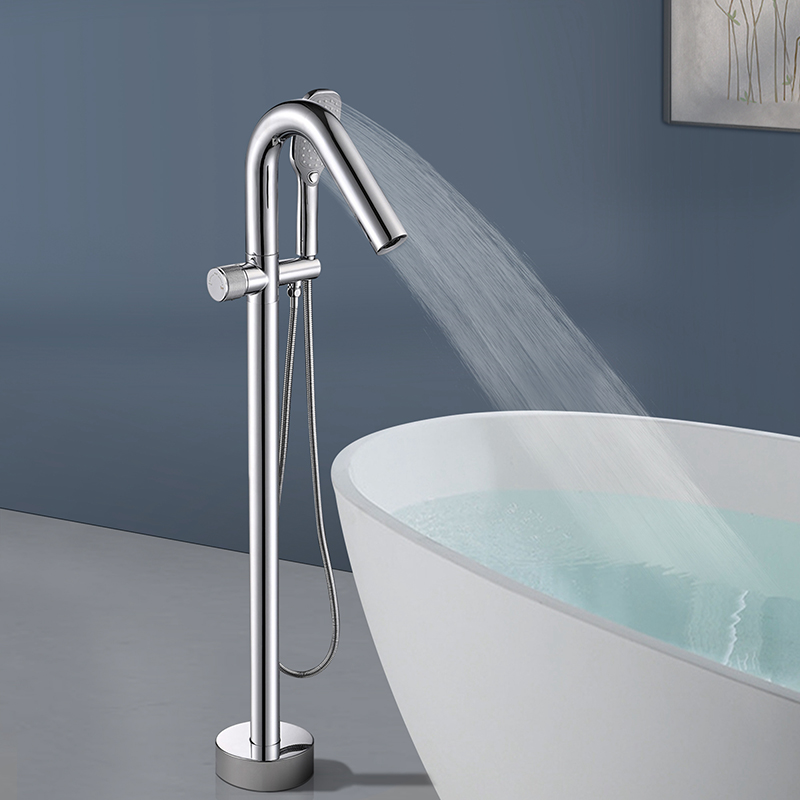
1. High Style vs. Poor Performance: The Hidden Bathing Frustration
In luxury hotel suites, boutique resorts, and modern residential master baths, waterfall bathtub faucets paired with premium handheld shower head systems represent the ultimate visual statement. They are a top choice for architects and commercial procurement managers (Commercial Bathtub Faucets).
However, post-installation dissatisfaction is surprisingly common. Homeowners and hotel project managers routinely complain about two major flaws:
- Painfully Slow Flow: Filling a standard 50-gallon soaking tub takes an intolerable 20 minutes!
- Internal Noise & Vibration: Turning the valves to full stream creates a deafening internal resonance—sounding like a roaring air chamber inside the wall.
The Root Cause: This frustrating “looks luxury, performs poorly” issue stems directly from unengineered internal geometry. Overly narrow internal waterways choke fluid dynamics (causing slow flow), while high-velocity water crashing into a wide open spout creates violent turbulence and cavitation resonance (generating internal pipe noise). A true commercial-grade solution requires fluid dynamics engineering from the inside out.
2. Structured Comparison: Basic vs. Engineered High-Flow Waterfall Faucet
For commercial buyers, project managers, and sanitaryware sourcing teams (Wide Channel Tub Filler Sourcing), the table below highlights the critical engineering distinctions:
| Feature | Basic Bathtub Faucets | Engineered High-Flow Waterfall Faucets |
| Waterway Architecture | Narrow DN15 (1/2″) tubing with restrictive internal bends. | DN20 (3/4″) Full-Port Straight Channel for minimal fluid friction. |
| Flow Rate Output | 3.0 – 5.0 GPM (Takes 15-20 minutes to fill a standard tub). | 8.0 – 12.0 GPM (Fills a full tub in just 5-8 minutes). |
| Flow Control Tech | No internal regulation or crude baffle plate, causing splashing turbulence. | Built-in multi-stage Laminar Flow Cartridge/Straightener for crystalline sheets. |
| Acoustic & Noise | High-frequency turbulence resonance & cavitation rumble (> 65 dB). | Smooth laminar output eliminates internal cavity vibration (< 35 dB, near silent). |
| Ideal Application | Low-volume vessel sinks or residential powder rooms only. | Luxury soaking tubs, commercial hospitality projects, paired with high-flow shower head units. |
3. Engineering Secrets: Mastering High Flow & Silent Operation
Delivering a high-flow, whisper-quiet waterfall spout requires overcoming three core Silent Faucet Internal Design challenges:
① Wide-Channel Architecture (DN20 Standard)
Why must B2B sourcing agents verify valve body and cartridge bore diameters? Standard waterfall tub fillers often repurpose basic basin cartridges with tiny 8-10mm internal apertures, choking water volume right at the inlet. Engineered High-Flow Waterfall Faucet systems utilize full-port Wide-Channel Architecture with DN20 (3/4-inch) valves, removing structural bottlenecks and delivering high-capacity gallonage directly to the tub.
② Micro-Laminar Flow Straightener
A wide spout alone does not guarantee a visually pleasing cascade. Without internal fluid alignment, water violently collides before exiting, causing spraying and harsh noise. Integrating a specialized multi-layer Laminar Flow Straightener inside the open spout reorganizes turbulent water molecules into parallel, crystal-clear streams. This creates a solid, silent “water wall” while eliminating air entrainment noise at the source.
③ Anti-Resonating Inner Cavity Casting
When high-volume water travels through a brass valve body, sudden structural transitions cause cavitation—microscopic vapor bubbles collapsing against metal walls and producing loud hums. Engineered Quiet Waterfall Tub Fillers feature topologically optimized inner cavity casting with smooth radii. This fluid transition eliminates internal eddies and prevents acoustic amplification across all pressure ranges.
4. FAQ
Q1: Why is my waterfall tub faucet running so slowly?
Answer: The most common reasons are restrictive internal plumbing, small 1/2″ basin cartridges used instead of dedicated high-flow tub valves, or undersized supply lines. For an effective Waterfall Tub Faucet Slow Flow Fix, upgrade to a wide-channel DN20 (3/4″) high-flow valve body and check supply lines for flow restrictions.
Q2: How do engineered waterfall faucets stay quiet at high flow rates?
Answer: Engineered faucets utilize an internal Laminar Flow Cartridge / Straightener to convert chaotic turbulence into a uniform, non-splashing water sheet. Combined with anti-cavitation internal body casting, this design solves the core engineering issue behind how to fix noisy waterfall faucet problems.
Q3: How to increase water flow in waterfall bathtub faucet systems with matching shower head?
Answer: To achieve optimal performance, ensure Wide Channel Tub Filler Sourcing specifications, install high-capacity high-flow diverter valves, and routinely clean inline debris filters to maintain unrestricted output across both the waterfall spout and the supplementary shower head.