

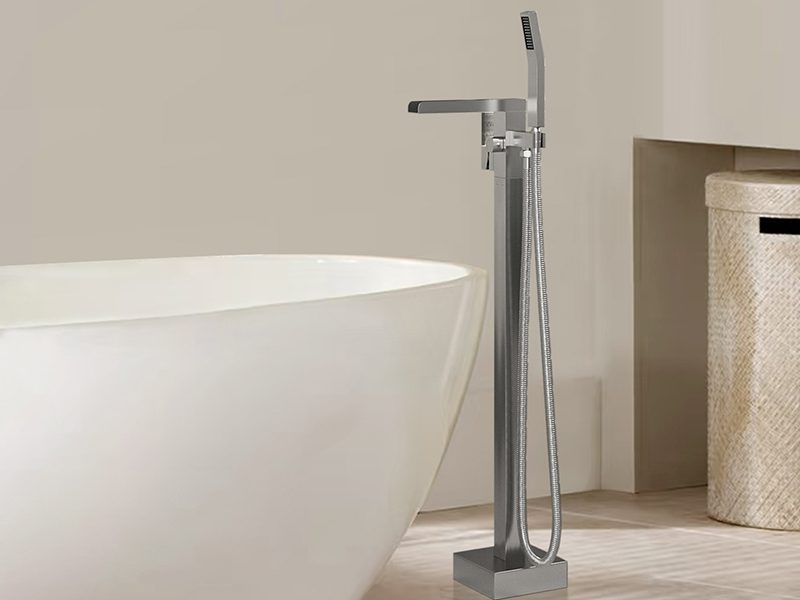
In sanitaryware manufacturing and project sourcing, the most damaging customer service issues rarely stem from major leaks. Instead, they are caused by tiny, overlooked hardware components. Picture a newly delivered luxury hotel project where the engineering manager calls in frustration: guests cannot switch water from the tub spout to the shower because the bathtub diverter valve stuck solid. Trying to force it pulls the stem out or snaps the rod, causing water to flood behind the wall.
For a component that costs less than two dollars at the factory level, brand owners end up paying expensive local technician fees, reimbursing guest stays, and risking losing their long-term project contracts.
When a bathtub faucet diverter button is hard to pull, it is rarely user error. It is a direct result of physical limitations inherent in standard hydraulic valve designs. To eliminate these warranty risks, procurement and engineering teams must understand the failure points of conventional diverters.
1. B2B Sourcing Guide: Why Conventional Diverter Valves Jam Under High Pressure
- Hydrostatic Pressure Lockup: In high-rise buildings or properties using powerful booster pumps (> 0.4 MPa), water pressure clamps the valve seal tightly against the seat. Lacking a pressure-relief mechanism, the hydrostatic differential creates a vacuum effect, forcing the user to pull against up to 50N of force.
- Limescale Binding in Hard Water Regions: Mineral deposits build up rapidly on raw brass stems or plastic sleeves. Once factory lubricant washes away, scale causes severe dry friction, leading to chronic bathtub spout to shower diverter jamming.
- Water Hammer Deformation: Shockwaves from daily shut-offs deform low-grade plastic skeletons over time, causing micro-misalignments inside the core that eventually lead to complete mechanical failure.
- Failure of Pressure-Dependent Reset: Diverters that rely solely on line-pressure differentials often fail to snap back under low or erratic water pressure, leaving the showerhead active unexpectedly next time the tap is opened.
2. Traditional Pull-Up Diverter vs. Topcraft Anti-Sticking Core
| Performance Metric | Traditional Pull-Up Diverter Valve | Topcraft Anti-Sticking Core | B2B Business & Warranty Impact |
| High-Pressure Response | Relies on manual force against full pressure (Jams above 0.35 MPa) | Built-in Pressure-Balanced Bypass Channels | Eliminates stuck switch claims in high-rise setups |
| Tactile Pulling Force | Force spikes as pressure rises (> 50N at 0.5 MPa) | Consistently smooth pulling force (<15N) at any pressure | Gives your bathtub faucet line a smooth, premium feel |
| Operating Pressure | 0.1 MPa – 0.35 MPa (Narrow functional window) | 0.05 MPa – 0.8 MPa (Booster pump compatible) | One versatile core suitable for global export markets |
| Anti-Scale Design | ABS plastic / raw brass rod + standard rubber | Low-lead brass + Teflon self-lubricating sleeve | Prevents mineral buildup and stem binding in hard water |
| Auto-Reset Reliability | Easily gets stuck halfway due to friction | Heavy-duty 304/316 spring for instant reset | Prevents accidental shower spraying when turned back on |
| Lifespan Testing | ~10,000–20,000 switching cycles | 100,000+ lifecycle switching test passed | Cuts return rates and secures final project payouts |
3. Engineering Innovations Behind the Topcraft Anti-Sticking Core
- Pressure-Balanced Bypass Channel: The moment the user touches the pull knob, micro-sized bypass ports open first to equalize internal pressure across the valve chamber, neutralizing over 90% of hydrostatic resistance.
- Teflon Self-Lubricating Sleeve: Enclosed in a polymer sleeve with low surface energy, the sliding stem repels calcium deposits, maintaining smooth operation even in hard water environments.
- Fatigue-Resistant Auto-Reset Architecture: Combined with a heavy-duty stainless steel spring, the valve snaps back to the tub spout position within 0.1 seconds of water shut-off.
4. B2B Sourcing & Engineering FAQ
Q1: Which bathtub faucet configurations can integrate this anti-sticking diverter technology?
A: Topcraft cores use standardized interface dimensions, making them compatible with wall-mounted bath mixers, freestanding bathtub faucet diverter units, concealed in-wall bathtub diverter valve assemblies, and multi-way shower valves.
Q2: How do you guarantee performance in commercial projects with high water pressure fluctuations?
A: Every production batch undergoes extreme 0.8 MPa hydrostatic testing, 100,000-cycle mechanical fatigue testing, and 24-hour salt-spray corrosion tests to ensure zero-defect delivery.
Q3: What OEM/ODM customization services does Topcraft offer to wholesale buyers?
A: We provide complete B2B support including custom dimensions, water flow rate matching, laser logo etching, private-label packaging, and priority bulk fulfillment.
Reliability builds brand equity in the plumbing business. A single failing bathtub diverter valve can destroy years of trust with key distributors and developers. Instead of spending resources managing warranty claims and product returns, upgrade your core engineering right at the manufacturing source.
If your bathtub mixer product line is facing issues with stuck diverters or snapped stems, reach out to the Topcraft engineering team today. We can provide full technical specifications, B2B wholesale pricing, and free evaluation samples to help you eliminate after-sales risks from your product line.