

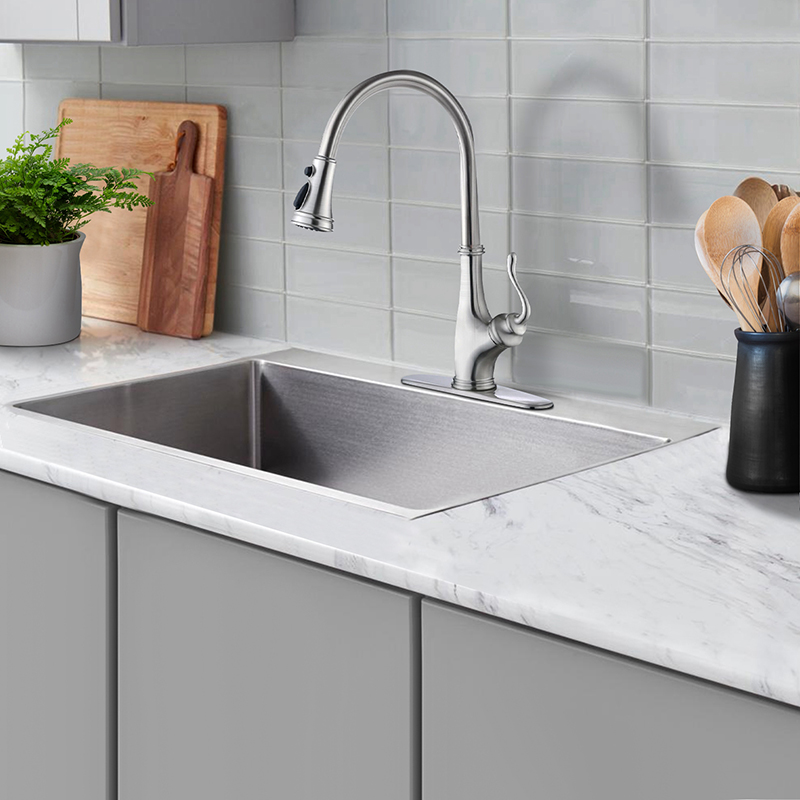
The kitchen faucet is easily one of the most common spots for home renovation regrets. It feels smooth and high-tech when first bought, but after a year, it gets stuck when pulled out, and the surface ends up covered in stubborn black rust spots that won’t wipe off.
This isn’t just bad luck—it’s the result of getting caught in marketing traps. Today, let’s bypass the fluff and analyze the engineering behind retraction failure and surface corrosion to help you get your kitchen hardware right the first time.
1. Retraction Failure: Gravity Ball vs. Spring Retraction—Which Stands the Test of Time?
With pull-out faucets, nothing is more frustrating than having to manually shove the hose back in after use. The market primarily relies on two retraction systems: Gravity Ball and Spring Retraction. Their long-term durability is worlds apart.
1. How They Work and Why They Fail
- Gravity Ball System:
- How it works: Uses physical gravity. A weight block of about 300g – 400g (usually cast iron or lead encased in plastic) is clamped onto a specific spot on the pull-out hose. When you pull the faucet out, the weight rises; when you let go, gravity naturally pulls the hose back down.
- Why it fails: Gravity never wears out, but physical space gets obstructed. In 90% of cases, weak retraction is not a system failure. Instead, under-sink items (water purifiers, garbage disposals, or trash bins) block the weight’s path, or messy hoses get tangled and cause friction.
- Spring Retraction System:
- How it works: Integrates a mechanical spring inside the faucet body or under-sink pipe to pull the hose back via tension.
- Why it fails: Irreversible metal fatigue. Every pull deforms the spring. In high-frequency kitchen environments, springs gradually lose elasticity over a few thousand uses. Worse, under-sink cabinets are notoriously damp; standard metal springs rust quickly, and once they snap, the retraction system is completely dead.
2. Structured Comparison: Gravity Ball vs. Spring Retraction
| Comparison Dimension | Gravity Ball System (Highly Recommended ⭐⭐⭐⭐⭐) | Spring Retraction System (Avoid ❌) |
| Theoretical Lifespan | Virtually Infinite (Gravity never degrades) | Limited (Typically fatigues within 2 – 5 years) |
| Failure Rate | Extremely low (Only prone to external physical blockage) | High (Loss of tension, rusting, snapping) |
| User Experience | Naturally increases in resistance as pulled, ergonomic | Uniform resistance, but becomes loose and saggy over time |
| Installation Space | Demands a clear vertical clearance under the sink | Very compact (Great for extremely cramped under-sink spaces) |
Pro-Tip for Installation:
Always choose a gravity ball system. If you have a water purifier or garbage disposal under the sink, tell your plumber to secure all loose cords and water lines to one side using zip ties/cable organizers. This creates a clear, dedicated path (about 15cm wide by 40cm high) for the gravity ball to travel freely.
2. Surface Rust & Corrosion: The 24h vs. 48h Salt Spray Test “Smokescreen” and Coastal Protection
Brands love to boast that their products “passed authoritative salt spray tests for rust-free performance.” However, without looking at the specific test parameters, this claim is often just marketing smoke and mirrors.
1. Breaking Down the Parameters: NSS 24h vs. ASS 48h
A hardware finish’s corrosion resistance is measured by salt spray testing. This is divided into Neutral Salt Spray (NSS) and Acid Acid Salt Spray (ASS), which differ drastically in severity.
- NSS (Neutral Salt Spray, pH 6.5 – 7.2): Simulates standard inland humidity and salinity.
- 24-Hour NSS: The absolute bare minimum industry baseline. Passing this only guarantees that in a dry, well-ventilated inland kitchen, the finish will stay corrosion-free for about 1 – 2 years.
- 48-Hour NSS: Mid-range hardware standard, keeping the surface bright and clean for 3 – 5 years in normal inland climates.
- ASS (Acetic Acid Salt Spray, pH 3.1 – 3.3): Introduces glacial acetic acid into the spray to simulate acid rain, high salinity, and extreme coastal humidity. It corrodes metals over 3 times faster than NSS.
- 48-Hour ASS: High-end, export-grade standard (equivalent to over 150 hours of NSS). Faucets that pass this test can withstand harsh coastal ocean winds and high-humidity environments for over 10 years without rusting or tarnishing.
2. How to Ensure Your Faucet Won’t Rust in Coastal/High-Humidity Areas
If you live near the coast or have a poorly ventilated bathroom or kitchen, look for these three specifications:
- Base Material: Reject Zinc Alloy, Insist on 304 Stainless Steel or H59 Brass
- Cheap faucets are often made of zinc alloy. Once the outer plating is nicked, zinc alloy oxidizes rapidly in damp air, forming white powder and causing the plating to bubble and peel.
- Best for Coastal Durability: Premium 304 Stainless Steel (Brushed Finish). Because it has no electroplating layer, there is nothing to peel off, and the alloy’s natural properties easily handle high humidity.
- Best for Premium Feel: H59/H62 Brass. Excellent antimicrobial and structural stability, but must be paired with high-spec surface finishing.
- Surface Process: Look for PVD (Physical Vapor Deposition)
- Traditional electroplating leaves microscopic pores on the surface, allowing coastal salt air to seep in and corrode the base metal from underneath.
- PVD coating (common on gunmetal grey or zirconium gold finishes) deposits metal atoms under high vacuum, forming an incredibly dense and hard protective barrier with exponentially higher corrosion resistance.
- The Golden Standard: Demand a “Grade 10 (ASS 48h)” Test Report
- Don’t rely on a sales rep’s verbal promise. Ask to see the third-party lab test report. Look for two critical metrics: “Test Type: ASS 48 Hours” and “Appearance Rating: Grade 10” (Grade 10 represents flawless, zero-defect performance).
3. Frequently Asked Questions (FAQ)
Q: My current gravity ball faucet has weak retraction. How can I fix it without replacing it?
A: 90% of retraction issues are not due to a broken faucet. Follow these three steps:
- Check under the sink. Ensure the gravity ball isn’t snagged on water filters, trash bins, or tangled hoses.
- If the space is clear, wipe down the pull-out hose with a damp cloth and a bit of dish soap. Over time, kitchen grease and grime build up on the hose, increasing friction and preventing it from sliding back.
- If it is still sluggish, purchase an inexpensive “clip-on gravity ball weight” online and attach it right next to the original one to double the pulling force.
Q: My faucet is already rusting and showing black spots. How do I clean it?
A: Never use steel wool, and never use harsh acids like toilet bowl cleaners! Steel wool scratches the plating, and strong acids eat through the protective layer, accelerating rust.
The Right Fix: Apply a small amount of metal polishing paste (or car scratch repair wax) to a soft microfiber cloth and gently buff the rusted areas. This physically lifts the oxidized layer and leaves a micro-thin layer of protective wax to slow down future tarnishing.