

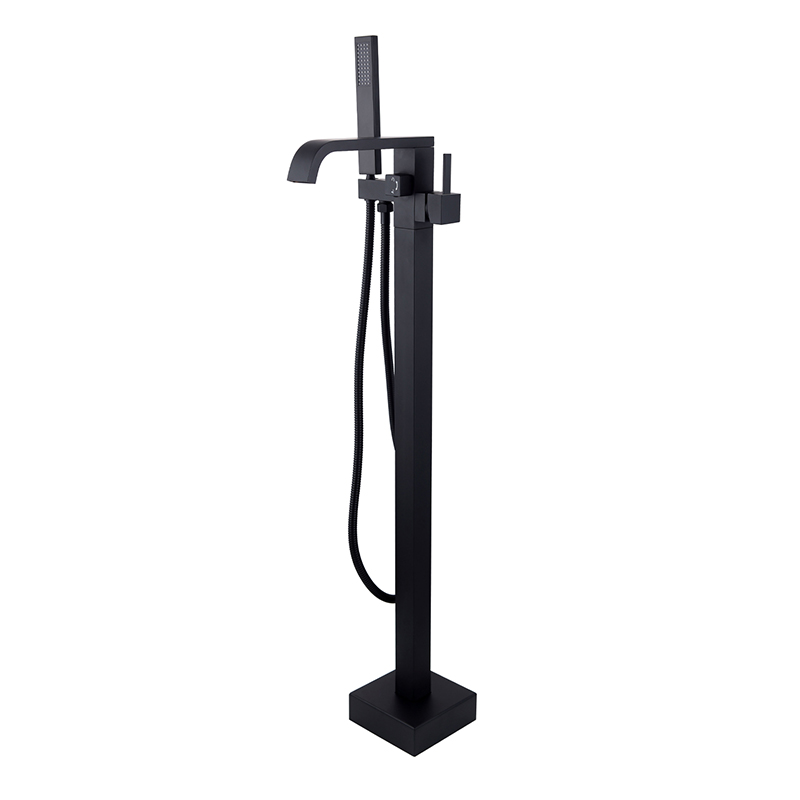
When a bathroom centers on a freestanding soaking tub, the faucet usually sits beside the tub rather than on the tub rim. These floor-mounted units — commonly called freestanding tub fillers or floor mounted bathtub faucets — combine a filler spout, a control handle, and in most cases a handheld shower on a flexible hose. If you are comparing options for a residential bathroom, a vacation rental, or a project order, the main decisions come down to mounting type, handle configuration, spout shape, finish, and whether the rough-in plumbing can accept a floor unit.
This guide walks through the categories shown in our current tub filler line, what separates one configuration from another, and the checks that matter before installation. Dimensions below are read directly from the product dimension drawings in the reference set; any spec not printed on those drawings is flagged in the notes at the end rather than assumed.
1. First, Match the Mounting Type to Your Tub
Not every bathtub accepts every faucet. The first question is where the faucet will be installed.
Freestanding / floor-mount tub filler. A tall column rises from the floor next to the tub, with a round or square base plate sitting on the finished floor. This is the style used with most standalone soaking tubs and clawfoot-style tubs where there is no wide deck to drill into. Because the supply lines run through the floor, the hot and cold stub-outs need to be set during rough-in, before the floor covering goes down.
Deck-mount / roman tub faucet. These sit on a flat tub deck or tub surround, with the spout and handles mounted on the horizontal surface. They depend on pre-drilled holes in the deck and a center-to-center hole spacing that matches the faucet. If the tub already has holes, that spacing has to be measured before choosing a replacement.
A practical way to tell them apart: a tall column standing on the floor next to the tub is a freestanding filler; a set of spout and handles sitting on the tub rim or deck is a deck-mount or roman tub faucet. A tub without a usable deck cannot take a deck-mount unit, and a finished floor without pre-set supply lines cannot take a floor unit without plumbing work.
2. Handle Configuration: Single Handle vs Double Handle
Tub fillers are grouped by how the hot and cold controls are arranged.
Single-handle fillers. One lever controls both flow and temperature; the handheld shower mounts to a separate holder on the column. This is the simpler, cleaner-looking setup in modern bathrooms, and it keeps the front of the column to one control. Units in this layout pair a horizontal filler spout, one control lever, and a slim handheld on a braided hose.
Double-handle fillers. Two separate handles — typically one for hot and one for cold — sit on the mixer body, above the tall filler spout. Units in this arrangement are paired with a high arched gooseneck spout and a handheld shower. Two-handle units read as a more traditional or exposed style, and temperature is balanced by adjusting each handle rather than one lever.
When choosing between them, it is mostly a matter of preference and style fit rather than a functional winner. Single handle is easier to operate with one hand; double handle leaves two visible controls on the mixer body.
3. Spout Shape: Gooseneck, Straight, and Waterfall
The spout changes both the look and the way water enters the tub.
Gooseneck / high-arc spout. A tall curved arm rises above the column and bends down over the tub rim. The arched spout gives enough clearance for water to fall into the tub without hitting the rim, and it is a common shape across the reference set.
Straight horizontal spout. A shorter, horizontal cylinder projects from the mixer body at mid-height. The spout points toward the tub rather than arching overhead.
Waterfall spout. A flat, wide outlet pours water in a broad sheet instead of a round stream. This open-channel waterfall outlet sits on a square column, with a handheld shower alongside, available in chrome, matte black, and oil rubbed bronze versions.
4. Finish Options in the Current Line
The reference set covers the main finishes buyers ask for:
- Matte black
- Brushed nickel
- Oil rubbed bronze / dark bronze
- Chrome / polished
- Brass / gold tone
Finish selection is usually driven by the rest of the bathroom hardware — door handles, towel bars, shower fixtures. Matte black pairs with modern and industrial schemes; brushed nickel and chrome sit in neutral, brighter bathrooms; oil rubbed bronze works with warm, traditional or darker schemes; a brass/gold tone adds a warmer accent. Note that the exact coating process and surface durability are not stated in the reference images, so finish-wear claims should be confirmed against the supplier spec sheet rather than described here.
5. Dimensions Worth Checking Before Ordering
For the freestanding units, the dimension drawings give the following readings. Numbers vary slightly by model, so treat these as reference ranges from the drawings in this set:
- Overall height (floor to top of spout): roughly 1160 mm to 1185 mm (about 45.7″ to 46.7″) on the units with dimension drawings.
- Spout reach / horizontal projection from the column: about 185 mm to 210 mm (roughly 7¼″ to 8⅛″) from the center of the column to the outlet.
- Base plate diameter: Ø160 mm (about 6 5/16″); base height about 50 mm (1 7/8″).
- Shower hose length: 1500 mm (59″) on one of the dimension drawings.
- Connection at the floor: one drawing marks a 3/8″ connection; confirm the actual inlet thread against the spec sheet for each model.
The checks that follow are general plumbing considerations rather than numbers from the drawings:
- Spout reach to the tub rim. The outlet needs to sit over the inside of the tub, not over the rim or the floor. Measure the distance from the planned filler location to the tub wall and compare it with the spout projection.
- Rough-in supply position. Floor-mount fillers need hot and cold supply stub-outs placed where the base plate will sit. On concrete slab or finished floors, this placement has to be settled before tiling or flooring; once the floor is down, moving the supply position means opening the floor.
- Floor support. The column base anchors to the floor; the mounting screws should land on a solid subfloor structure where possible, not only on finished floor material.
- Do not use the filler as a grab bar. Standard installation instructions for freestanding fillers caution against leaning on or holding the faucet for support when entering or leaving the tub.
6. What Comes in the Package
The parts photo for one floor-mount filler shows the typical kit contents for an assembled unit: the mixer body with spout and handles, the handheld shower, the flexible shower hose, the riser column, the round base plate, connection fittings, mounting screws, and an installation instruction sheet. Hardware included can differ between models, so check the packing list on the specific SKU before ordering replacements or estimating install labor.
7. How the Reference Line Breaks Down by Category
Based on the folders and photos in the product set:
| Category in the line | Layout | Finishes in the set |
| 2 Handle Tub and Shower Faucet | Two handles, gooseneck spout, handheld shower | Brass/gold, matte black |
| Freestanding Tub Faucet | Single control, arched spout, handheld shower | Matte black, oil rubbed bronze |
| Single Handle Bathtub Faucet | One handle; straight or gooseneck spout | Brushed nickel, matte black |
| Tub and Shower Faucets | Mixer column with handheld shower assembly | Brushed nickel, matte black |
| Waterfall Bathtub Faucet | Square column, waterfall outlet, handheld shower | Chrome, matte black, oil rubbed bronze |
Frequently Asked Questions
What is the difference between a tub filler and a roman tub faucet?
A tub filler usually means a freestanding, floor-mounted column next to a soaking tub. A roman tub faucet is deck-mounted on a flat tub deck or surround, with the spout and handles sitting on the horizontal surface. The core difference is where the unit mounts: floor vs deck.
Do freestanding tub fillers come with a hand shower?
Many do. Most of the units in this reference set pair the filler spout with a slim handheld shower on a flexible hose, used for rinsing the tub, washing pets or children, or directing water while cleaning. Confirm the handheld and hose are included in the specific SKU you are looking at, since some filler-only configurations may not include them.
What height is a typical freestanding tub filler?
On the dimension drawings in this set, the overall height runs roughly 1160–1185 mm (about 46 inches). Height can vary by model, so use the drawing for the exact SKU rather than a generic standard.
Can I install a floor-mounted tub filler on an already finished floor?
Only if the hot and cold supply stub-outs are already in place under the planned location. If the floor is finished and no supplies were roughed in, running new lines usually means opening the floor; this should be confirmed with a licensed plumber for your site.
Which finish hides water spots and scratches best?
Matte black and brushed nickel tend to show water spots and fingerprints less than polished chrome; bronze finishes can also soften marks. Because finish durability and scratch resistance are not documented in the reference images, treat this as general appearance guidance and check finish-care notes in the spec sheet.