

SEO title options
- White Ceramic Farmhouse Kitchen Sinks: Single vs Double Bowl, Installation & Care
- Apron-Front Ceramic Kitchen Sink Buying Guide: Bowl Layout, Mount Type and Maintenance
- Smooth vs Fluted Fireclay Apron Sinks: How to Choose for Your Kitchen
Meta description: Compare white glazed ceramic (fireclay-style) apron-front kitchen sinks: single bowl vs double bowl, smooth vs fluted apron, drop-in vs undermount installation, cabinet support, glaze quality and daily care tips before you buy.
Target keywords (use naturally across title, H2s, image alt text and FAQ): fireclay farmhouse sink, white ceramic kitchen sink, apron front sink, farmhouse kitchen sink, double bowl farmhouse sink, single bowl apron sink, fluted apron sink, ribbed farmhouse sink, smooth apron front sink, drop-in ceramic sink, undermount ceramic sink, white fireclay sink, kitchen sink buying guide, ceramic sink maintenance, apron sink cabinet requirement.
Introduction
White glazed ceramic apron-front sinks — often listed in the market as fireclay farmhouse sinks — give a kitchen a cleaner, lighter focal point than a standard stainless steel bowl. For homeowners and trade buyers, though, the visible finish is only the first decision. Basin layout, mounting method, cabinet support, glaze quality and daily maintenance decide whether the sink remains easy to live with after installation.
This guide covers the broad product category of white glazed ceramic apron-front (farmhouse-style) kitchen sinks sold in overseas home and DIY channels, including the two configuration styles buyers most often compare: a smooth-face equal double-bowl design and a fluted, vertically ribbed single-bowl design. It explains how the material works, how to choose between bowl layouts and apron faces, what installation requires, how ceramic compares with other sink materials, and the items to check before ordering.
Note on terminology: product listings sometimes use “ceramic,” “fireclay” and “vitreous china” interchangeably. For any specific SKU, confirm the body material, firing description and finish from the official spec sheet rather than the listing title. This guide deliberately avoids assumed dimensions, weights and ratings; those must come from the product specification.
1. What Is a Ceramic / Fireclay Apron-Front Kitchen Sink?
A farmhouse sink, also called an apron-front sink, is defined by its exposed front panel that extends slightly over the cabinet face. The category shown in this guide consists of white glazed ceramic basins: a dense clay body covered with a smooth white glaze, with the front apron forming part of the visible kitchen facade.
In North American and European retail markets, well-made units of this style are commonly described as fireclay: a clay body fired at high temperature until it becomes dense, then coated with a glaze that fuses into a hard surface. General characteristics associated with that construction include:
- A smooth, glossy or matte-white glazed surface that everyday stains such as coffee, tea, tomato sauce and red wine can be wiped off.
- A relatively dense body that muffles the sound of cookware and a garbage disposal compared with thin stainless steel.
- A clean white appearance that pairs with dark shaker cabinets, light wood fronts, marble or quartz counters and modern or transitional layouts.
- A deep basin profile suited to washing pots, pans and baking items.
Trade buyers should verify the actual material statement on the spec sheet, because labels vary between factories and product ranges. The useful questions are: what clay body, how the glaze covers the apron and underside, what corner radius the bowls have, and whether the listing states net weight and cabinet requirement.
2. Why Buyers Still Choose White Glazed Ceramic Sinks
Stainless steel remains the practical default, but buyers choose white ceramic apron sinks for specific reasons.
Visual centerpiece. The white apron front becomes a design element, especially in farmhouse, country, transitional and bright modern kitchens. A smooth flat face reads modern and minimal; a fluted ribbed face adds traditional texture.
Stain-resistant glazed surface. When the glaze is intact and evenly applied, food colorants do not penetrate the surface the way they can into exposed metal or porous composite, and rinsing removes most residue quickly.
Quieter daily use. The thicker, denser body generally produces less ringing noise when dishes or pans are set down, and less hollow tone under a disposal, than thin-gauge stainless steel.
Coordination with fixtures. White glaze works with chrome, brushed nickel, matte black, oil-rubbed bronze and brushed gold faucets, so the sink does not lock the buyer into one fixture finish.
The trade side of the decision matters just as much. Ceramic is heavier than stainless steel, more fragile under impact, and exact sizing and installation support must be confirmed before purchase. The sections below work through those points.
3. Single Bowl vs Double Bowl: Which Layout Fits Your Routine?
No layout is universally better; the choice follows how the kitchen is used.
Single-bowl apron sink
A single-bowl sink has one uninterrupted basin. It suits buyers who:
- Regularly wash stockpots, roasting pans, baking sheets and cutting boards that do not fit inside a divided bowl.
- Run a dishwasher for most tableware and use the sink mainly for prep and large items.
- Want fewer seams, corners and a divider to wipe clean.
- Prefer a simpler plumbing arrangement with one drain.
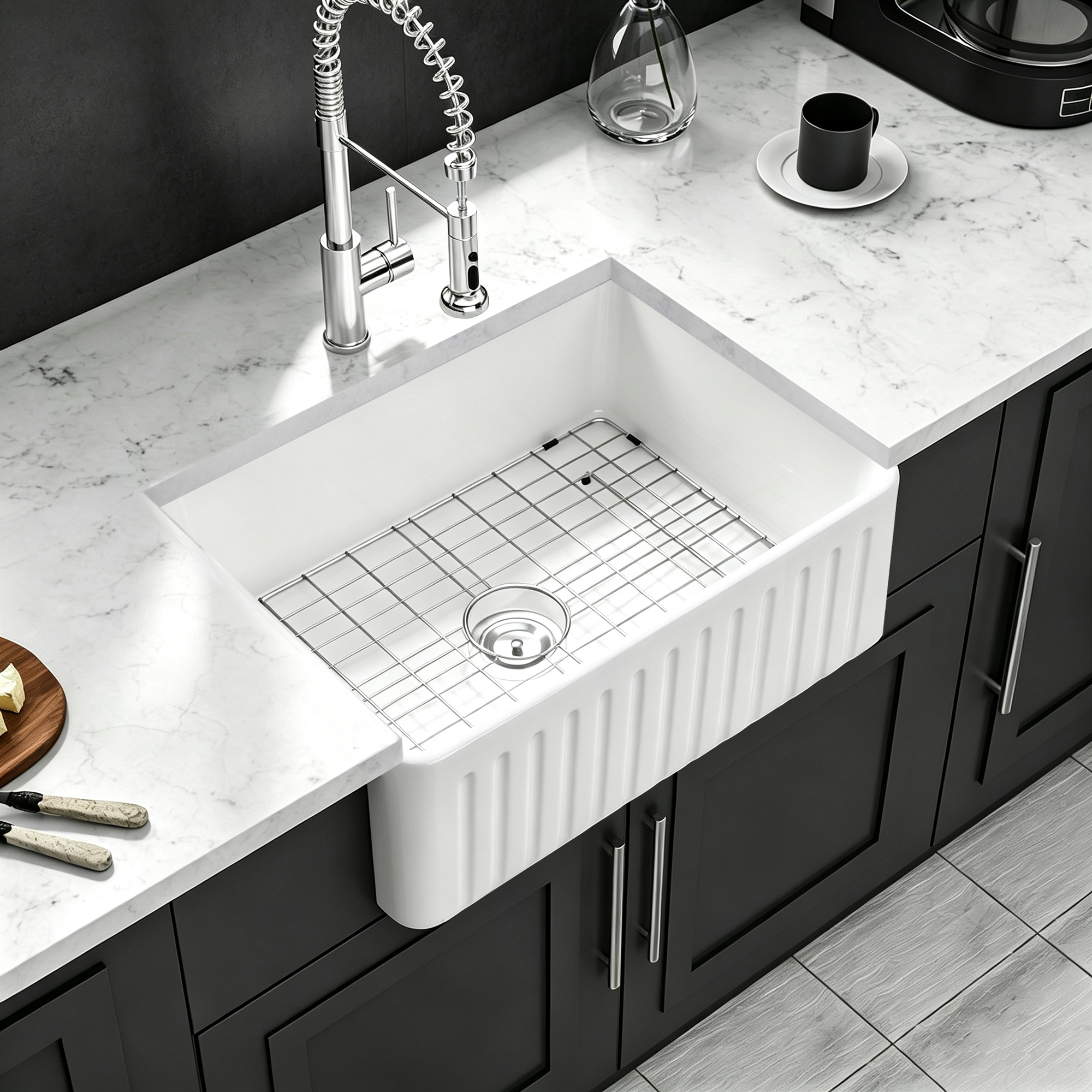
The fluted single-bowl style belongs to this family: one deep basin, often paired with a textured apron front for visual character.
Double-bowl apron sink
A double-bowl sink provides two separate basins, usually equal size or in a 60/40 split (one larger, one smaller). It suits buyers who:
- Hand-wash dishes often and want one side for washing, the other for rinsing.
- Soak cookware on one side while using the other for food prep or rinsing produce.
- Prefer separating raw items from ready-to-eat items during cleanup.
- Want one bowl reserved for a drain rack or a garbage disposal while the other stays usable.
Points to weigh:
- Each basin is narrower than a single bowl of the same overall width, so oversized pans may not lie flat.
- Two drains and fittings mean slightly more under-sink plumbing.
- The center divider and its corners add cleaning points.
- A 60/40 split can be a middle ground: the larger basin handles cookware, the smaller basin handles rinsing or disposal.
Quick decision: choose a single bowl if large items and dishwasher-primary habits dominate; choose a double bowl if daily hand-washing and multitasking at the sink dominate.
4. Apron Face: Smooth Flat Front vs Fluted Ribbed Front
The apron face changes the style more than it changes function, and it is one of the clearest style separators within the ceramic farmhouse category.
- Smooth / flat apron front. A clean, unbroken white face that suits modern, minimalist and transitional kitchens. It wipes clean quickly and reads as a wide, calm horizontal panel; equal double-bowl models often use this treatment for a symmetrical look.
- Fluted / ribbed apron front. Vertical grooves on the apron add texture and a traditional farmhouse or country character; this face appears frequently on single-bowl traditional designs. Some market models are reversible, allowing one face smooth and one face fluted to be selected during installation; confirm reversibility for the specific SKU before assuming it.
- Practical note: grooves can collect dust and water marks along the ridges; a quick wipe after use keeps the face looking even.
Color-wise, bright white remains the dominant option. Matte white, black and other glazes exist in the category, but finish samples should be approved before bulk orders because glaze tone can vary slightly between production lots.
5. Installation Types and Cabinet Support
Ceramic sinks can appear in different mounting configurations, and “farmhouse apron-front” describes the visible style rather than one unique installation method.
Apron-front (farmhouse) installation
The front apron sits flush or slightly proud of the cabinet face. Compared with a standard top-mount sink, this usually means:
- The cabinet front must be trimmed or fitted for the apron, or a retrofit / short-apron model chosen.
- The sink body rests on support rails or a brace inside the cabinet; reinforced framing is recommended because ceramic sinks are substantially heavier than equivalent stainless steel units.
- Exact net weight and the manufacturer’s recommended support method should be taken from the spec sheet, not estimated from appearance.
Drop-in / top-mount installation
The sink’s rim or mounting deck rests on top of the countertop cutout, and the bowl drops into the opening. Advantages include simpler fitting over an existing countertop and a more accessible retrofit when the cabinet below cannot be heavily modified. A visible rim line remains around the opening.
Undermount installation
The sink is mounted beneath the countertop, giving a seamless look where water can be wiped directly off the counter into the bowl. Requirements include:
- A countertop material and underside structure capable of supporting the sink.
- Clips, gaskets and sealant applied according to the manufacturer’s template.
- Internal cabinet support, because the bowl weight does not rest on a top rim.
Sizing the sink to the cabinet
Always measure the sink base cabinet itself, not the old sink on top of it. Market guidance commonly pairs sink width with a slightly wider base cabinet to leave room for walls, mounting hardware and plumbing; the exact relationship depends on the model’s cutout dimensions. Request the cutout template, minimum cabinet width, drain center locations and faucet hole count from the supplier before finalizing cabinetry.
Other fit checks:
- Faucet hole count and position on the deck; room for a pull-down, gooseneck or spring pre-rinse faucet.
- Garbage disposal compatibility, especially the flange needed for a deep ceramic bowl.
- Basket strainers or drains included, and whether a bottom grid or protective rack is available.
- For the US market, confirm any paired faucet meets local lead-content requirements for wetted surfaces; sink body and faucet compliance are separate checks.
6. Ceramic / Fireclay vs Other Common Sink Materials
The table below compares general market characteristics. Treat it as a selection framework; specific products vary by build quality.
| Attribute | White glazed ceramic / fireclay apron sink | Stainless steel | Quartz / granite composite | Enameled cast iron |
| Visual style | Bright white, farmhouse/traditional to modern | Industrial, neutral; limited color | Solid matte, modern-rustic | Classic glossy white; very heavy |
| Surface staining | Glaze resists common food stains; wipe clean | Water spots and fine scratches show over time | Non-porous overall; dark colors hide marks well | Enamel resists stains when intact |
| Scratch behavior | Resists fine surface wear; avoid abrasive scouring | Develops fine scratches with use | Hard surface; moderate scratch resistance | Enamel can scratch; bare metal undercoat may show |
| Impact / chip risk | Can chip or crack if a heavy pan hits the edge or apron | Dents or bends rather than cracks; tolerates impact | Resists cracking; chips possible on edges | Brittle; chips expose dark iron under enamel |
| Weight and install support | Heavy; needs cabinet support and careful handling | Lighter; simpler fitting, more size options | Moderate to heavy; requires support | Very heavy; robust support usually required |
| Noise | Dense body dampens pan and disposal noise | Can ring unless thick-gauge and sound-damped | Moderately quiet | Dense and quiet when enameled |
| Maintenance | Rinse and wipe; no abrasives or harsh chemicals on glaze | Water-spot wipe-down; avoid scouring pads | Follow manufacturer cleaner guidance | Gentle cleaning; protect enamel from chips |
| Best fit | Buyers prioritizing appearance, farmhouse style and stain-resistant glaze | High-use kitchens, cook-heavy workflows, easy retrofit | Buyers wanting color and scratch-forgiving composite | Classic look where very heavy weight is acceptable |
A common shortcut is “ceramic for looks, stainless for abuse.” That direction holds in broad terms, but a well-built deep stainless sink can outlast a poorly supported ceramic one, so installation quality and daily handling matter as much as material.
7. Daily Care for a Glazed Ceramic Kitchen Sink
Proper care preserves the glaze rather than requiring special treatment.
- Rinse after use. Wash away food residue and standing water; a wipe with a soft cloth prevents hard-water spots from drying on the white surface.
- Use mild cleaner. Warm water and a mild dish soap or manufacturer-recommended ceramic cleaner are sufficient. Avoid steel wool, abrasive scouring powders and stiff pads that can dull or mark the glaze.
- Limit harsh chemicals. Avoid prolonged contact with concentrated bleach, strong acids or aggressive descalers; check product directions and rinse after use.
- Protect the bowl bottom. A stainless or silicone bottom grid keeps cookware from sliding on the glaze and absorbs small impacts; it also lifts items off wet surfaces.
- Handle cookware carefully. Do not drop cast-iron pans or heavy skillets onto the rim, apron or bowl bottom, and avoid sliding them across the surface. Let very hot pans cool before prolonged contact to reduce thermal shock risk; use a trivet where recommended.
- Maintain drains and strainers. Empty the basket strainer regularly, keep the drain center clear, and check the seal and gaskets during cleaning.
- Inspect the apron and edges. Chip damage usually appears at the rim corners or the lower apron edge; note it early, because cracked glaze can progress if left unprotected.
- Do not seal the body. Glazed ceramic does not require sealing; sealing products are not a substitute for intact glaze.
8. Pre-Order Checklist: Retail Buyers and Wholesale Buyers
Use this list before final payment or bulk ordering.
Measurement and fit
- Sink base cabinet width, depth and interior support condition.
- Supplier cutout template and minimum cabinet width requirement.
- Overall and bowl dimensions, basin depth, front-to-back depth.
- Drain position and number of drains (single = one, double = two).
- Faucet hole count, spacing and deck length; faucet and soap dispenser fit.
- Garbage disposal model compatibility and required flange.
Build and finish
- Stated material (fireclay / ceramic / vitreous china) and glaze finish type (glossy or matte).
- Glaze coverage on apron, rim and underside; even color; no visible cracks, pinholes or unglazed spots.
- Bowl corner radius and drain slope toward the center for self-draining cleaning.
- Reversibility claim (smooth vs fluted face) verified, if applicable.
- Included accessories: basket strainers, bottom grids, mounting clips, sealant, template.
Structural and logistics
- Net weight and recommended cabinet support or bracing method.
- Package crating, foam corner protection and freight inspection policy; ceramic can chip in transit.
- Sample or finish approval before bulk run, including acceptable glaze-tone tolerance between lots.
- Warranty, replacement and return terms for glaze defects and shipping damage.
- Local compliance checks for paired faucets and any required plumbing certification.
9. Choosing Between Common Category Configurations
Within the white ceramic apron-sink category, two configuration styles come up most often in buyer comparisons. They are style archetypes, and individual SKUs may combine elements of both.
Smooth-face double-bowl style fits a kitchen where:
- Dishes are frequently hand-washed and wash/rinse separation matters.
- The desired look is a clean, symmetrical, traditional white apron.
- Cabinet width supports two basins and two drain connections.
- Multitasking at the sink (soak, rinse, prep) outweighs the need for one extra-large basin.
Fluted single-bowl style fits a kitchen where:
- Large cookware and sheet pans need one open basin.
- Dishwasher-primary cleanup leaves the sink mainly for prep and bulky items.
- A textured traditional farmhouse character on the apron is preferred over a flat smooth face.
- The buyer wants a simpler one-drain plumbing setup.
When neither routine dominates, compare actual bowl depths, widths and cabinet measurements before deciding on visual style alone.
Conclusion
White glazed ceramic apron-front sinks remain popular because they solve two problems at once: they provide a durable, stain-resistant daily washing surface, and they give the kitchen a recognizable farmhouse focal point. The decision process starts with the owner’s kitchen habits — single or double bowl — then moves to apron style, mounting method and cabinet support, and finishes with glaze quality, accessories and care habits. Specifications should be taken from the supplier’s official data sheet, installation should follow the provided template, and the support structure should be confirmed before the countertop is cut. With those steps checked, a white ceramic farmhouse sink can stay clean and functional through long-term daily use.
Suggested FAQ block (optional, good for on-page SEO)
Q: What is the difference between a farmhouse sink and an apron-front sink?
They are generally the same style: an exposed front panel that extends over the cabinet face. The terms are often used interchangeably in listings.
Q: Are fireclay sinks better than stainless steel?
Not universally. Fireclay wins on appearance, stain resistance and surface quietness for many kitchens; stainless steel wins on impact tolerance, light weight, ease of installation and lower freight risk. Choose based on daily use and installation constraints.
Q: Can a ceramic apron sink be installed as a drop-in?
Some models use a top-mount deck or retrofit design; others are undermount or apron-specific. Verify the mounting method and support requirement for the exact model.
Q: Do ceramic farmhouse sinks scratch easily?
The glazed surface resists everyday fine wear, but abrasive pads and dropped heavy cookware can mark or chip it. Use a bottom grid and avoid sliding cast-iron items across the bowl.
Q: What size cabinet do I need for a farmhouse sink?
Measure the base cabinet and match it to the supplier’s minimum cabinet width and cutout template; farmhouse and apron-front units typically need reinforced support inside the cabinet.
Image alt text suggestions
- White ceramic double-bowl farmhouse sink installed on marble counter with dark cabinets
- Top view of equal double-bowl white apron front sink with basket strainer drains
- Fluted ribbed white ceramic single bowl farmhouse sink front view
- Vertical grooved apron front close-up of white glazed ceramic kitchen sink
- White fluted single apron kitchen sink in modern kitchen with chrome gooseneck faucet