

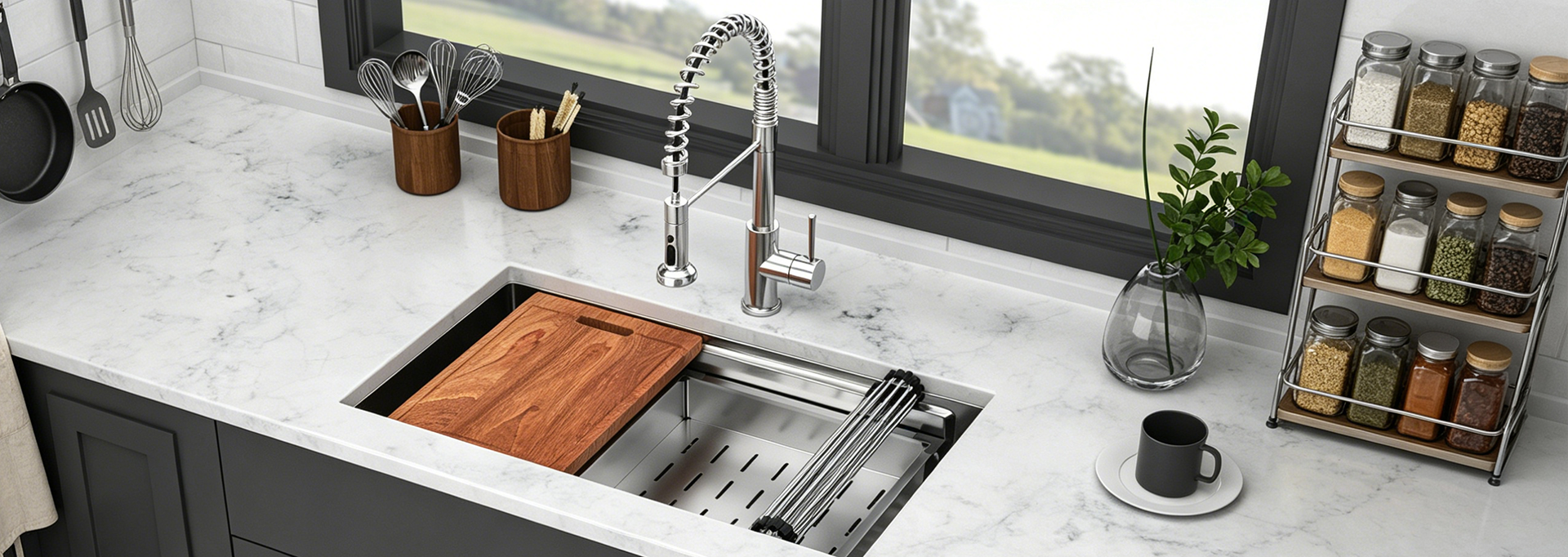
In a chaotic commercial kitchen or a bustling, shared culinary space, the absolute last thing you need is a gear meltdown. Yet, the single most overlooked headache for property managers and maintenance crews is a busted pull-out kitchen faucet hose. You know the drill: you install a brand-new setup, and within a few months, it’s already snagging, fraying, or slow-dripping all over the cabinet floor. Most buyers only look at the shiny finish or the spray features, completely missing the real MVP that dictates durability. If you want to stop burning money on repairs, finding the best commercial pull out kitchen faucet comes down to looking beneath the surface at the inner tube hidden beneath the braid.
As an industry insider who has handled countless commercial-grade fit-outs and product failures, I can tell you that almost every premature hose leak or retraction failure comes down to choosing the wrong inner lining. Today, we’re cutting through the marketing noise to pit the two heavyweights—EPDM (Ethylene Propylene Diene Monomer) and PEX (Cross-linked Polyethylene)—against each other to see which one actually survives high-frequency friction and brutal hot-and-cold cycles.
🛠️ PEX vs. EPDM: The Hardcore Performance Showdown
Why do some hoses last for years without a hitch while others turn into a leaky, shredding mess in six months? It isn’t luck; it’s science. It comes down to material fatigue, high-temperature tolerance, and chemical leaching.
Here is how the two stack up based on the latest third-party friction and wear testing data:
| Performance Metric | EPDM Rubber Inner Tube (The Standard Budget Option) | PEX Inner Tube (The Commercial-Grade Beast) | Real-World Impact on High-Traffic Kitchens |
|---|---|---|---|
| High-Frequency Bend & Friction Life | ≤ 50,000 cycles (Prone to cracking and flaking later on) | ≥ 200,000 cycles (Zero cracks, zero deformation) | Drastically cuts down on maintenance calls and costly downtime. |
| Long-Term High-Temp Stability | Hardens, shrinks, and gets brittle under constant 158°F+ (70°C+) water | Rock-solid under constant 203°F (95°C); handles thermal shock like a pro | Perfect for heavy-duty hot water sanitizing and commercial recirculating loops. |
| Water Quality & Leaching | Degrades over time, leaching rubber particles and odors; clogs aerators | Zero chemical leaching; NSF-certified for safe drinking water; odorless | Keeps prep water pristine; eliminates odor complaints and clogged lines. |
| Creep Resistance & Retraction | Sags and loses elasticity after heavy use, causing the hose to droop | Snaps right back into shape; smooth inner walls keep retraction flawless | Keeps the pull-out action smooth as butter, eliminating “sagging faucet syndrome.” |
| Pressure & Aging Resistance | Warps under constant pressure; degrades quickly; seals give out | Handles high-pressure spikes; UV-resistant and anti-oxidation | Built to survive 24/7 commercial operations, extending the faucet’s lifespan. |
💡 The Real Talk Breakdown:
- EPDM (Rubber) Tubes are the old-school industry baseline. They do just fine in low-use, room-temp residential settings. But throw them into the commercial meat grinder—where they are constantly yanked around and blasted with scalding water—and the rubber molecules quit. The tube cracks, and the resulting rubber debris acts like a pipe clogger, killing your water pressure and causing leaks at the joints.
- PEX Tubes are the high-tech upgrade engineered specifically for heavy abuse. Investing in an nsf certified pex kitchen faucet supply line guarantees your prep water stays 100% safe and odor-free. Thanks to a specialized cross-linking process that rewires its molecular structure, PEX completely eliminates the aging flaws of traditional rubber. Even if dishwashers yank it hundreds of times a day, the inner wall stays perfectly smooth. No flaking, no warping, no drama.
🏃 Going the Distance: The Two Outer Elements That Make or Break Your Hose
Getting the right inner tube is only half the battle. The outer braided jacket and the weight setup dictate whether your hose glides like a dream or grinds to a halt.
1. Outer Braid: Stainless Steel vs. High-Density Nylon
- Stainless Steel Braid: Sounds tough, but metal-on-metal friction is a nightmare. As it rubs against the cabinet interior or the counterweight, it creates a loud, annoying scraping sound. Over time, individual wire strands can fray and snap, acting like tiny needles that puncture the inner hose.
- High-Density Nylon Braid: Upgrading to a flexible nylon braided faucet hose for kitchen sink applications ensures a quiet, friction-free glide. This material is ultra-flexible with a super-low friction coefficient. It resists fraying, runs completely silent, and won’t chew up your hardware. Pair it with a PEX inner tube, and you get a double-layer defense system that easily doubles the lifespan of the hose.
2. The “Sweet Spot” Rule for Counterweight Placement
If you’re trying to figure out how to fix pull out spray hose not retracting, the issue might just be your counterweight geometry rather than a broken part. When a hose refuses to snap back into place, installers usually blame the hardware when they should blame the installation layout:
- Too close to the faucet base: The hose takes a sharp bend every time you pull it, concentrating all the stress on one tiny section, causing premature snapping.
- Too far away: There isn’t enough leverage to pull the spray head back up, leaving it dangling like a sad noodle.
- Pro tip: The sweet spot for mounting the counterweight is 7 to 10 inches (18–25 cm) from the faucet base. This distributes the tension evenly, keeps the snap-back crisp, and minimizes friction wear.
💰 The Bottom Line: Stop Paying the “Cheap Hose” Tax
It’s tempting for purchasing managers to save a few bucks upfront by opting for cheap EPDM hoses with generic braiding. But look at the long-term math. By the time you factor in the plumber’s service fee, the kitchen downtime, and the cost of buying three replacement hoses over the lifespan of one good one, that “budget” hose becomes incredibly expensive. If you’re tired of constant maintenance, it’s time to upgrade to a heavy duty pull out kitchen faucet hose replacement that actually holds up. Smart operators know that doing it right the first time is the only way to save money.
At Topcraft, we live and breathe commercial-grade durability. That’s why our entire line of commercial pull-out kitchen faucets comes standard with German-standard thickened PEX inner tubes and high-density, anti-friction nylon braided hoses. Our hoses are torture-tested for 200,000 high-frequency flex cycles and slammed with 203°F (95°C) water to ensure they never leak, sag, or fail on the job.
Ready to bulletproof your kitchen plumbing? Head over to the Topcraft Official Website to check out our specs and grab a copy of our commercial project catalog!
❓ FAQ
Q: I’m outfitting a low-use office breakroom. Can I get away with an EPDM rubber hose?
A: In the short term, sure. But keep in mind that rubber naturally degrades over time even if it’s just sitting there. After a year or two, you’re still likely to deal with sluggish retraction or that funky rubber taste in the water. For absolute peace of mind and clean drinking water, PEX is still the smarter play.
Q: Is there a way to tell if my current hose is PEX or EPDM without cutting it open?
A: Yep, disconnect one of the end fittings and look inside. EPDM looks like matte, dull rubber; if you pinch or bend it hard, it’ll leave a permanent crease or white stress mark. PEX has a smoother, slightly glossy finish; if you bend it and let go, it snaps right back like a spring with zero crease lines.
Q: My hose has a tiny pinhole leak. Can I just wrap it in silicone tape or swap the outer braid?
A: Don’t waste your time. The outer braid is just armor; it doesn’t hold water pressure. If it’s leaking, the inner tube is already ruptured. Slapping tape on the outside is just a temporary band-aid that will blow out in a matter of hours. You need a complete hose replacement.
Q: Do high-end PEX hoses require any special maintenance?
A: Nope, they are completely set-it-and-forget-it. Just make sure your crew isn’t violently yanking the hose past its maximum extension limit, and keep the area under the sink clear so the hose doesn’t snag on sharp objects. Wipe down the outer nylon braid occasionally to remove dust, and it’ll easily go the distance.