

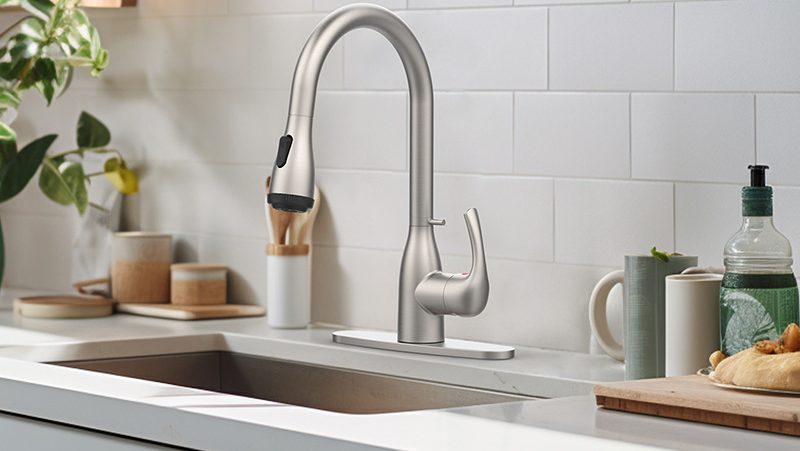
Driven by post-pandemic health awareness and smart home adoption, touchless kitchen faucets have transitioned from luxury fixtures into standard inclusions for mid-to-high-end residential and commercial builds. However, for B2B procurement professionals, importers, and brand owners, electronic plumbing fixtures carry a distinct risk: field failure rates are significantly higher than traditional mechanical mixers. Combining micro-electronics with water lines under a humid, cramped kitchen sink is a recipe for warranty claims if supplier engineering isn’t vetted properly.
In the kitchen, two technical factors determine whether a product earns five-star reviews or tanks your brand’s reputation: Anti-False Triggering and Power Management.
This evaluation blueprint covers how to audit both before issuing your next purchase order.
Why Kitchen Environments Kill Weak Electronic Faucets
Unlike bathroom sensor taps—which handle simple, predictable handwashing—kitchen touchless faucets operate in chaotic conditions:
- High-Reflection Interference: Shiny stainless steel sinks, dark granite countertops, reflective copper cookware, hot steam, and passing pets constantly disrupt the optical path.
- Under-Sink Power Limits: Over 60% of residential kitchens lack a dedicated under-sink AC outlet, forcing reliance on battery boxes where frequent battery swaps ruin the user experience.
- Debris & Scale: Kitchen water supply lines carry fine grit and mineral deposits that easily jam cheap solenoid valves, leading to continuous leaking or total shutoff failure.
Evaluating Anti-False Triggering Technology
Sensor reliability depends on the underlying hardware architecture and the software filtering algorithms loaded onto the chip.
Sensing Technology Comparison for B2B Sourcing
| Sensor Type | Operating Principle | Performance in Kitchen Environments | Cost & Recommendation |
| Infrared Reflection (IR) | Emits and detects reflected IR light to identify objects. | Moderate. Black cookware can absorb the beam; dark marble or stainless steel reflections cause ghost triggers. | Low Cost. Mature tech. Sourcing requirement: Must include an ambient-light self-calibration algorithm. |
| Capacitive Touch | Changes capacitance when a user touches any metal part of the body. | High. No optical window to get dirty. Prevents visual false triggers, but requires physical touch. | Mid-Tier. Excellent for full-body touch control lines. Requires strict waterproofing and anti-static protection. |
| Time-of-Flight (TOF / Laser) | Measures photon travel time to establish an exact distance boundary. | Very High. Immune to target color, surface reflectivity, or steam. Stops triggering past set millimeter limits. | Higher Cost. Recommended for premium OEM/ODM product lines where call-back rates must be near zero. |
| Dual-Mode Composite (IR + Pull-Out Sensor) | Combines side IR sensing with a microswitch in the pull-out spray head. | Highest. Pulling the spray head activates flow automatically; returning it stops flow. Complemented by side IR. | Strongly Recommended. The ideal balance of ergonomics and reliability for commercial and high-end retail. |
3 Non-Negotiable Algorithmic Checks
When testing factory samples, verify these three software safeguards:
- Strict Sensing Range (5–10 cm): The detection field must be locked between 5 cm and 10 cm. Anything broader will trigger the faucet every time someone chops vegetables near the sink rim.
- 180-Second Auto Shut-Off: A mandatory 3-minute continuous run cutoff prevents catastrophic kitchen flooding if an object accidentally falls into the sensing zone while the owner is away.
- Steam and Ambient Light Resistance: Test samples under dense hot steam and direct high-intensity light to ensure the sensor does not freeze or continuously cycle on and off.
Power Management Architecture
Most battery-powered touchless kitchen faucets run on 4 or 6 AA alkaline batteries, or offer dual AC/DC power options. Achieving a 12-to-24-month lifespan requires low-power circuit optimization.
Power Supply Options Comparison
| Power Option | Application & Characteristics |
| AC 110V–240V Adapter | Requires a pre-installed outlet under the sink; ideal for new construction or commercial builds. |
| AA / AAA Battery Box | No electrical wiring required; essential for retail, e-commerce, and renovation/retrofit markets. |
| Hydro-Electric Module | Harvests energy from water flow to supplement battery life; higher unit system cost. |
Critical Battery & Lifespan Benchmarks
- Quiescent Standby Current (< 50 μA): The control module must draw under 50 μA while idle. High standby current drains the batteries in a few months even if the faucet is rarely used.
- Operational Lifespan Targets (at 50 cycles/day):
- Acceptable Standard: 4 AA batteries last 12 months (approx. 20,000 switching cycles).
- Premium Standard: 18–24 months (35,000–40,000 cycles) achieved using a bistable latching solenoid valve, which only draws power during the quick millisecond pulse that flips the valve open or closed.
- Fail-Safe Low-Power Protection: When battery capacity drops below 10%, an LED indicator should flash to notify the user. Crucially, the control box must forcibly close the solenoid valve before power dies completely. It must never fail in the “open” position.
- Manual Override: The system should include a mechanical bypass switch so users can revert to standard manual handle operation if the electronics or batteries fail entirely.
Hardware Ingress Protection and Component Quality
Under-sink cabinets are humid, harsh environments subject to condensation and plumbing leaks.
- IP67 Rated Modules: Both the main electronic control box and the battery enclosure must carry an IP67 dust- and water-resistance rating.
- Threaded Waterproof Connectors: Wire leads between the sensor and control box should use aviation-style threaded plugs with internal O-rings, rather than basic unsealed plastic clips.
- 100-Mesh Washable In-Line Filter: A removable mesh filter upstream of the solenoid valve is required to catch sediment, rust, and pipe scale before particles jam the internal membrane.
B2B Quality Assurance and Testing Checklist
Require your manufacturing partner to provide certified test reports verifying these parameters before issuing production approval:
- Damp Heat Cycle Test: The control box must operate without short circuits after 48 hours in an environmental chamber set to 40°C and 95% relative humidity.
- Solenoid Life Cycle Test: Require a factory test report proving at least 500,000 continuous open/close cycles without seal breakdown or mechanical sticking.
- ESD Immunity Test: Must meet IEC 61000-4-2 standards so static electricity built up on users during cold months won’t fry the sensor IC.
Frequently Asked Questions (FAQ)
Which sensor type has the lowest warranty return rate for e-commerce brands?
Dual-mode composite systems (Pull-out spray sensor combined with a side IR sensor) and Time-of-Flight (TOF) sensors yield the lowest defect rates. Standard single-beam IR sensors trigger higher return rates due to interference from dark granite countertops or reflective stainless steel pans.
Why do some touchless faucets make a clicking or buzzing sound without releasing water?
This typically happens when low battery voltage cannot generate enough magnetic force to flip a latching solenoid valve, or when mineral scale jams the valve piston. A proper circuit design prevents this by monitoring voltage limits and shutting down safely before reaching that threshold.
Is a hydro-electric power module worth the added BOM cost?
For luxury retail lines or high-traffic commercial projects, yes. For volume-focused retail sourcing, standard 4xAA battery setups paired with bistable pulse solenoid valves offer better cost efficiency and fewer mechanical parts to maintain.
Planning your next OEM/ODM touchless faucet run or updating your factory sourcing specs? Our engineering team designs, seals, and tests sensor kitchen components strictly to IP67 and 500,000-cycle commercial standards. Contact our technical team today to request sample test reports, review customized control box options, or discuss factory-direct production scheduling for your brand.