

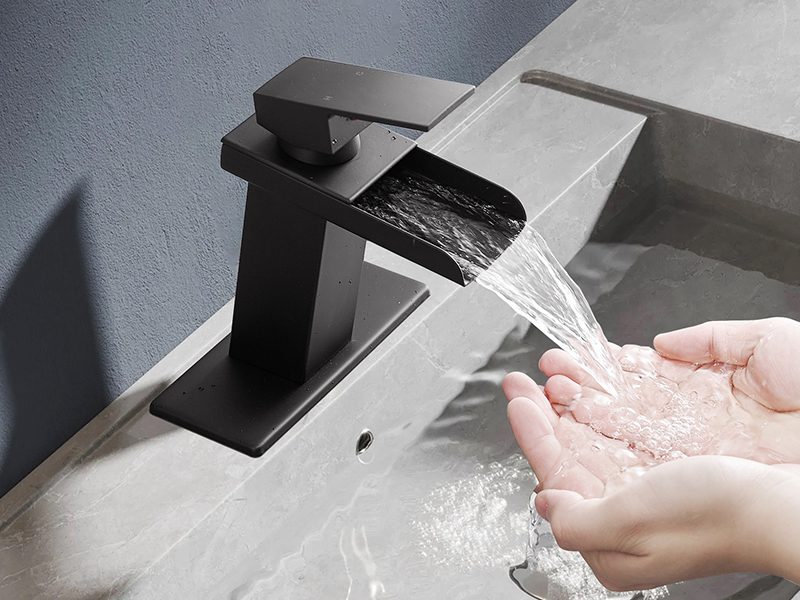
Matte black kitchen faucets remain a consistent top-seller for wholesale distributors and commercial project buyers. However, surface scratches, flaking, and paint chipping account for over 40% of all after-sales quality claims on black sanitary ware.
For professional procurement teams and wholesalers, understanding the structural differences between PVD (Physical Vapor Deposition) Coating and Standard Spray/Powder Paint is essential to reducing product liability and securing profit margins.
1. Technical Principles: Physical Layer vs. Molecular Fusion
The durability of a black faucet depends entirely on how the finish bonds to the metal substrate (SUS304 stainless steel or H59 brass):
- Standard Spray / Powder Paint (Physical Surface Layer)Paint or powder resin is electrostatically applied and heat-cured onto the surface. The finish relies purely on mechanical interlocking without chemical bonding. Exposure to kitchen humidity, hot steam, and harsh cleaners breaks down the organic binders over time. Under friction from cookware or cleaning pads, the paint chips easily, exposing the bare metal underneath.
- PVD Coating (Molecular / Crystalline Fusion)Conducted inside a high-vacuum chamber, metal targets (Titanium or Zirconium) are vaporized, ionized, and accelerated by electric fields to deposit a crystalline layer directly onto the substrate. PVD does not sit on top of the metal; it fuses into the lattice. With a surface hardness of HV 1500–3000 (nearing diamond hardness), PVD finishes resist scratches and will not peel under standard kitchen use.
2. Technical Metric & Cost Comparison
| Metric | PVD Physical Vapor Deposition | Standard Spray / Powder Paint |
| Bonding Mechanism | Atomic/Molecular Bond (Fused to metal) | Physical Adhesion (Mechanical surface coat) |
| Surface Hardness | HV 1500–3000 (High scratch resistance) | HB 2H–4H (Soft layer, easily scratched) |
| Scratch Resistance | Superior (Withstands steel wool & utensils) | Poor (Scratches easily under keys & rings) |
| Adhesion Rating | Class 0 (Highest ISO standard; zero flaking) | Class 2–3 (Prone to blistering & flaking) |
| Acid Salt Spray (ASS) | 24–48+ Hours without pinhole rust | 12–24 Hours (Prone to edge corrosion) |
| Thermal Resistance | High (Withstands >400°C & chemical cleaners) | Low (Steam degrades paint binders over time) |
| Defect / Return Rate | < 1% (Consistent long-term quality) | 15% – 40% (High risk of warranty claims) |
| Unit Sourcing Cost | +30% to +50% unit cost premium | Low cost (Suited for budget volume orders) |
3. On-Site QC Inspection Protocol for Buyers
When inspecting bulk orders, procurement teams should mandate the following 4-step quality control protocol:
- Initial Phase: Sample Selection (Sampling)
- Step 1: 3M Cross-Hatch Tape Test
- Step 2: Coin / Key Scratch Test
- Step 3: ASS Salt Spray Report Verification
- Step 4: Acid & Alkali Immersion Test
- 3M Cross-Hatch Tape Test (ISO 2409) Cut a $1\text{mm} \times 1\text{mm}$ grid into a concealed surface, apply 3M 600/810 tape firmly over the grid, and snap it off at a 45° angle. PVD finishes show clean lattice edges with zero flaking (ISO Class 0).
- Coin & Key Scratch Test Drag a coin edge or brass key across a hidden section under moderate pressure (~10–15N). A genuine PVD finish will show no white gouges or exposed substrate.
- Acid Salt Spray (ASS) Verification Require factory lab reports confirming Acid Salt Spray (ASS) for 24+ hours or Copper-Accelerated Salt Spray (CASS), rather than standard Neutral Salt Spray (NSS).
- Thermal Shock & Chemical Resistance Test Submerge test samples in standard household cleaning solutions for 24 hours and run hot/cold water cycles to verify coating stability.
4. Key Procurement Specifications
- Specify AF (Anti-Fingerprint) Nano-Coating Matte black surfaces easily show water spots and finger smudges. Request suppliers to apply an AF hydrophobic nano-coating over the PVD layer. Water beads off immediately, making routine cleaning easy while improving the tactile feel.
- Multi-Material Color Consistency Pull-down kitchen faucets feature brass/stainless steel bodies, ABS spray heads, and nylon braided hoses. Require strict color matching ($\Delta E < 0.5$) before mass production to maintain uniform aesthetics across all components.
5. Frequently Asked Questions (FAQ)
Q: Is PVD coating worth the 30%–50% price premium for bulk procurement?
A: Yes. Evaluating the Total Cost of Ownership (TCO) favors PVD. A 40% return rate on cheap spray-painted faucets quickly consumes upfront savings through replacement expenses, freight losses, and damaged client trust.
Q: Why do budget black faucets turn grey or dull over time?
A: UV light, steam, and household cleaners break down the organic polymer chains in spray paint, causing oxidation and chalking. PVD coatings utilize inorganic metallic nitrides that never undergo photo-oxidation fading.
For large-scale orders, manufacturing partners like Topcraft utilize lead-free brass and SUS304 stainless steel substrates paired with automated PVD and AF coating lines, providing verified ASS lab reports to help wholesalers and procurement buyers minimize after-sales risks.